Big gains to be made from Genotyping Scheme
Date published:
“To make good genetic progress you need to breed from your best cows.” This is a statement from Albert Wallace who farms along with his son William just outside Tobermore.
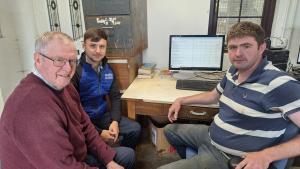
Together they have a dairy herd of approximately 115 cows which in the last year had an average yield of 11,600 litres at 4.48% butterfat and 3.64% protein, producing an amazing 940 kg milk solids per cow per year.
Over the years Albert and William have always bred a functional Holstein-Friesian cow that isn’t too angular and selected sires that have good figures for both butterfat and protein percent, fertility, longevity, feet and legs, and not forgetting milk of course.
They recently registered with the Bovine Genetics Project through the Sustainable Ruminant Genetics (SRG) website (srgni.com). Here they can access a range of useful reports relating to both overall enterprise performance and reports specific to individual cows. Using data from their milk processor, the SRG Dairy Herd Performance Report highlighted that the Wallace’s herd ranked in the top 4% of producers for milk yield and the top 3% for combined fat and protein yield. The herd produced an average of 799 kg of fat and protein per cow per year, compared with an average of 572 kg across other herds.
The Wallace’s have always adopted the latest breeding innovations to make genetic improvements. They have been using sexed semen for the last 17 years, resulting in fewer cows required to generate replacements. Albert, who still looks after breeding decisions, quickly saw how genetic progress could be accelerated by only breeding from his best cows. Cows and heifers are ranked on profitable lifetime index (£PLI) to identify the best, and for the last six years has been genotyping his heifer calves to get an earlier and more accurate assessment of their genetic merit. As a result, most cows and heifers within the herd are genotyped, and as a rule, those with a £PLI of over £300 are bred to Holstein with the remainder inseminated with a beef straw.
Since 2019, the Wallace’s have milked their cows with a robot. While there is still a lot of emphasis on milk quality and the functional traits, there is now more focus on milk yield to maximise profit per robot and cubicle space.
Albert has always been keen to select bulls that were carriers of the A2 gene for beta casein which leads to fewer digestive problems in humans drinking milk, but also carriers of the BB gene for kappa casein which is associated with an increase in cheese yield when processed. Albert was also very interested to see that based on his genotyping results, the SRG genetic report was able to identify cows which carry one or two copies of each of these genes – and that in future these cows could be used to breed the next generation of replacements.
To encourage uptake of genotyping and improve the genetic merit and production efficiency of the Northern Ireland dairy herd, genotyping is being supported by the Northern Ireland Bovine Genetics Genotyping Scheme. This scheme opens on 1 September 2026 for the genotyping of current and future breeding stock (cows, heifers and bulls) with the genotyping of all calves, male and female, opening on 1 January 2027. The additional tags and genotyping will cost farmers £13 per animal. This cost is being covered by DAERA through the Bovine Genetics Genotyping Scheme.
For information on how to register for the Bovine Genetics Project and access genotyping for your herd visit srgni.com or contact SRG at telephone 028 2046 2280 or contact your approved tag supplier.
Notes to editors:
- Follow DAERA on X formerly called Twitter and Facebook.
- All media queries should be directed to the DAERA Press Office pressoffice.group@daera-ni.gov.uk or telephone: 028 9016 3460.