CAFRE agriculture students explore progressive farming systems in Scotland
Date published:
Students completing the Level 3 Advanced Technical Extended Diploma in Agriculture (ATEDA) at the College of Agriculture, Food and Rural Enterprise (CAFRE) recently undertook a study tour to Scotland which provided them with insights into a range of modern and progressive farming enterprises. The trip provided students with valuable exposure to innovative practices across a range of livestock systems.
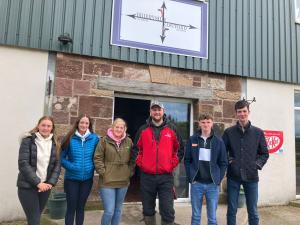
Myremill Farm: Embracing Technology in Dairy Production
The first visit was to the Myremill Farm near Maybole in Ayrshire which is farmed by the Lowrie family. This multi-generational dairy farm supports around 300 Holstein and pedigree Ayrshire cows, alongside 300 youngstock.
The farm has recently modernised through the installation of a robotic milking system, reflecting a growing industry trend towards automation. These systems allow cows to be milked more frequently and on their own schedule, which often leads to increased milk yields. Kevin Lowrie highlighted the importance of herd management technology in monitoring health, fertility, and performance, while maintaining a strong focus on cow comfort through investment in housing and ventilation.
Darnlaw Farm: The Role of Genetics and Breeding
The second visit took students to the Darnlaw Farm in Ayrshire where the Sloan family manage a 190-cow Holstein-Friesian herd. The herd is milked using robots and cows are housed year-round.
A key focus of the visit was genetics and selective breeding, with all animals pedigree registered. Robert Sloan emphasised the benefits of using sexed semen, which has enabled him to produce high-quality pedigree heifer calves for sale and showing, providing an additional income stream. Students gained a clear understanding of how breeding decisions can significantly influence herd development.
Parkend Farm: Improving Efficiency Through Automation
On day two, the group travelled to the Parkend Farm of Brian Weatherup, near Cowdenbeath in Fife. The farm supports approximately 160 Holstein cows, with a strong reputation for pedigree breeding and show success.
Recently the farm transitioned to robotic milking to overcome labour challenges and improve work-life balance. The change resulted in immediate benefits, including increased efficiency and more time for detailed herd management. Strong emphasis is also placed on breeding and genetics, contributing to both high herd performance and success in the show ring.
Over Finlarg: A Diverse Hill Farming Enterprise
The tour then continued to Over Finlarg, an upland farm near Dundee managed by Robert and Hazel McNee. Spanning over 1,200 acres and rising to 1,200 feet above sea level, the McNee family have significantly improved the land through reseeding, drainage, fencing, and infrastructure development.
The farm operates a diverse livestock system including 1,100 breeding ewes and a 200-cow suckler herd. The sheep enterprise includes several breeds, producing both commercial and pedigree stock. The beef enterprise is equally successful, focus on both maternal and terminal traits as well as breeding high-quality bulls.
Holehouse Farm: Managing a Large-Scale Mixed Enterprise
On day three, students visited the Holehouse Farm at Kilbirnie, a large-scale 4,767-acre mixed enterprise run by the Logan family. The farm integrates dairy, beef, and sheep production across multiple farm units, including a 280-cow Holstein herd and a 160-head suckler herd.
Students were given a tour of the facilities and Alistair Logan discussed key management practices used to optimise performance, such as infrared scanning for body condition scoring, automated feed pushers, and precision feeding systems. Students also observed the farm’s 1,700 Blackface ewes grazing on hill ground, with breeding strategies focused on producing high-quality replacement females.
West Galdenoch: Large-Scale Dairy Production
The final visit was to the West Galdenoch Farm of Gary Mitchell, near Stranraer. This large-scale dairy unit supports 1,300 Holstein cows which are milked through a 70-point rotary parlour. There herd combines impressive milk yields with high compositional quality. Gary discussed the use of a “flying herd” system, whereby calves are reared off-site to improve efficiency and allow the farm to focus on milk production.
Overall, the study tour provided CAFRE students with valuable insights into modern agricultural practices, particularly in relation to technology adoption, genetics, and large-scale farm management. From robotic milking systems to innovative breeding strategies and diverse livestock enterprises, the visits highlighted the importance of adaptability and forward-thinking within the agricultural industry.
CAFRE is very grateful to The Gibson Trust for contributing to the costs of the study tour for the final year Level 3 ATEDA students and wishes to put on record their thanks to all of the farms who hosted visits and took time out from busy schedules to enable students to tour their facilities.
The study tour provided a welcome opportunity for students to connect with their classmates as their three years of Level 3 study at CAFRE come to an end and they move forward on the next stage of their career journey. Whether the students progress onto higher level courses, enter employment, or return to their home enterprises, they will always have great memories of their study tour to Scotland.
If you, or someone you know is considering leaving school after Year 12, CAFRE offers full-time and part-time courses in agriculture. For more information, please visit the CAFRE website.
Notes to editors:
- Photo caption: CAFRE Level 3 Advanced Technical Extended Diploma in Agriculture students Emma Quinn (Dungannon), Emma Hegarty (Lurgan), Aileen O’Reilly (Middletown), Matthew Sloan (Randalstown) and Martin McCrory (Omagh) pictured with host farmer Kevin Lowrie (centre) as they visited Myremill Farm as part of their study tour to Scotland.
- Follow DAERA on X formerly called Twitter and Facebook.
- All media queries should be directed to the DAERA Press Office: pressoffice.group@daera-ni.gov.uk or telephone: 028 9016 3460.