The Gibson Trust supports CAFRE’s agriculture study tour to Wales
Date published:
Level 3 Advanced Technical Extended Diploma in Agriculture (ATEDA) students at the College of Agriculture, Food and Rural Enterprise (CAFRE) recently embarked on a study tour across Wales and south-west England.
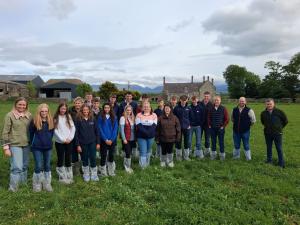
The tour provided an excellent opportunity to experience a range of farming enterprises, from award-winning livestock systems and genetics to renewable energy and farm diversification. Throughout the trip students gained valuable insights into how modern agriculture is adapting to meet the challenges of productivity, sustainability and environmental responsibility.
Castellior Farm - Award-winning beef production
The first stop of the tour was Castellior Farm, Anglesey, where students met Dylan Jones, winner of both the Farmers Weekly Beef Farmer of the Year and British Grassland Society Farmer of the Year awards. The beef finishing enterprise handles approximately 1,500 - 1,600 cattle annually while maintaining a strong focus on sustainability.
Students learned how home-grown cereals and forage crops are incorporated into a Total Mixed Ration and discovered the role of red clover in improving soil fertility through nitrogen fixation. The visit also highlighted how data driven management, efficient feeding and environmental stewardship can work together to create a profitable and sustainable beef business.
Cogent Breeding Stud - Advancing livestock genetics
The second day began with a visit to Cogent UK near Chester, a leading provider of bovine genetics. Students explored the importance of artificial insemination, genomic testing, and precision breeding technologies in improving herd performance. Industry specialists demonstrated how genetic information is used to enhance fertility, health and production traits, helping farmers make informed decisions to support long-term efficiency and sustainability.
The group were particularly interested in learning how breeding decisions based on data can deliver long-term improvements in both dairy and beef enterprises.
Grosvenor Farms - Sustainable dairy farming on a large scale
The group then travelled to Aldford Hall Farm which is part of Grosvenor Farms and one of the UK's largest dairy farms. Operating a herd of 2,500 cows and producing over 34 million litres of milk annually, the business demonstrated how large-scale dairy farming can successfully integrate sustainability into everyday operations.
Students toured the milking facilities and learned about feeding systems, forage management and nutrient recycling between dairy and arable enterprises. The farm’s use of renewable technologies provided a further dimension to the visit, including anaerobic digestion and solar energy as part of their commitment to environmental challenges and net zero carbon goals.
Moo’trition - Adding value through diversification
The Study Tour then visited Moo’trition at Huntington Hall Farm. This diversification enterprise adds value to milk produced on the farm through direct sales of fresh milk, milkshakes, ice cream and coffee. Students learned about branding, marketing and consumer engagement while seeing how diversification can create additional income streams.
A viewing gallery overlooking the dairy provides visitors with a unique opportunity to watch the milking process, helping to improve public understanding of modern dairy farming. Sampling the ice cream and milkshakes was a particular highlight amongst the students.
Fferam Gyd - Grassland farming and rural diversification
On the final day, students visited Fferam Gyd, Llanbabo, where Llyr Fferam showcased his grass-based beef and sheep enterprise alongside his Pabo Limousin herd. The visit highlighted the benefits of effective grazing management and low-input farming systems. The farm is also home to 34 wind turbines, demonstrating how renewable energy generation can contribute to the long-term financial resilience of farming businesses.
The visit provided valuable insight into the challenges and opportunities associated with family farming and highlighted how diversification can support business sustainability in an increasingly changing agricultural landscape.
The study tour provided students with a comprehensive and immersive learning experience across a range of agricultural systems. Students returned with a deeper understanding of sustainability, innovation and the practical realities of farming. The knowledge and experiences gained throughout the tour will support their future studies and help prepare them for careers within the agri-food industry.
CAFRE is deeply indebted to The Gibson Trust for contributing to the costs of study tours for the final year Level 3 ATEDA students at Greenmount Campus. The study tour also provided the opportunity for students to connect with each other one final time as a group, before embarking on their own career paths. Some of the students will continue their studies on higher level courses, some will enter employment, while others will return to their home enterprises to work alongside family members.
If you, or someone you know is considering leaving school after Year 12, CAFRE offers full-time and part-time courses in agriculture, please visit CAFRE website to find out more.
Notes to editors:
- Follow DAERA on X formerly called Twitter and Facebook.
- All media queries should be directed to the DAERA Press Office: pressoffice.group@daera-ni.gov.uk or telephone: 028 9016 3460.