Incorporating white clover into grassland swards on beef and sheep farms
Date published:
College of Agriculture, Food and Rural Enterprise (CAFRE) Beef and Sheep Adviser, Nigel Gould outlines how incorporating white clover into grass swards can help reduce fertiliser inputs while maintaining performance.
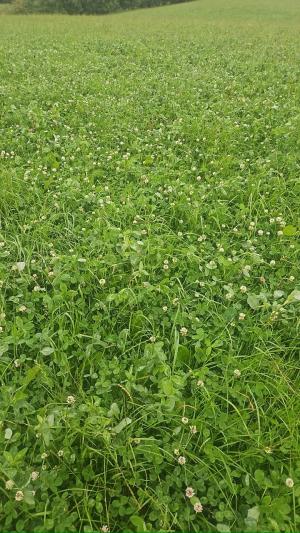
Mixed white clover/grass swards, when managed effectively, have the potential to reduce chemical nitrogen inputs by 150-180 kg N/ha, while maintaining grass yields, compared to a grass-only sward. This is equivalent to 4.4-5.3 50kg bags of CAN fertiliser worth between £101 and £122/ha (assuming CAN costs £460/tonne).
A key driver of profitability on most beef and sheep farms in Northern Ireland is maximising the proportion of grazed grass and conserved silage and reducing concentrate input. Volatility in supply and price of chemical fertiliser in recent years, in addition to environmental concerns have led to a renewed interest in the incorporation of white clover into both grazed and silage swards.
To achieve the optimum benefit, white clover content needs to be 20-30%. Clover content is often overestimated visually and that 20–30% botanical composition may look like 40–60% ground cover at peak growth. In addition, research has shown that increased daily live weight gain can be achieved in both cattle and sheep grazed on mixed white clover/grass swards. This is in part due to the higher dry matter intakes associated with increased palatability, increased forage digestibility, mineral and protein content.
Most of the environmental benefits of white clover are attributed to its ability to fix nitrogen (N) from the air and convert it to a form which can be released into the soil and utilised by grass. This is achieved by beneficial rhizobium bacteria in the root nodules of the white clover plants. A white clover content of 20-30% is generally considered optimum as total sward yield may be reduced where clover content is higher. A higher rate of N fixation is possible where clover content is higher, however there is an increased risk of nitrogen losses to water where the grass sward isn’t sufficient to utilise this additional nitrogen. It is important to note that white clover generally has limited ability to fix nitrogen for the first 12 months.
Successful establishment of a white clover sward is best achieved via a full reseed, however, stitching in and broadcasting can also be used under the right conditions. Stitching in and broadcasting will be heavily dependent on sufficient soil moisture retention for germination and a suppression of the existing sward by cutting the sward for silage or by grazing tight beforehand. Good soil fertility is key to successful establishment and maintenance of clover. Soil pH generally needs to be a little higher for clover than grass – a pH of 6.5 is required. Target phosphorus and potassium indices of 2+.
White clover is generally categorised by leaf size – small, medium or large. Small-leaved varieties are generally best suited to grazed sheep swards. Medium-leaved varieties are best suited to cattle grazing or rotationally grazed sheep swards. Large-leaved varieties are best suited to silage production or rotationally grazed cattle swards.
There are currently no Northern Irish recommended grass and clover lists published, however, the DAFM Recommended List (RoI) and the AHDB Recommended Grass and Clover Lists (UK) can be used to identify superior clover and grass varieties, depending on the traits you wish to target. Weed control is often cited as a challenge for grass clover sward establishment and maintenance due to difficulties in sourcing a product which targets all problem weeds, without affecting clover.
Maintaining clover content can be just as challenging as getting it established. Clover works well in rotational grazing systems where the plant is allowed a rest period. White clover is stoloniferous, which means it spreads above ground via stolons, after which the new plant puts down its own established root system. Constant heavy trampling of these stolons can deplete the energy reserves of the new plant before it becomes established.
Clover often struggles more in an intensive silage system as it competes with the grass in the sward. Sometimes, chemical nitrogen fertiliser rates are too high, resulting in a thick grass sward where light is unable to reach the base of the clover plant. Grazing the sward well towards the end of the year will encourage clover. A high level of management, coupled with good soil fertility, will maximise success.
Ultimately, success with white clover comes down to good management. Paying attention to soil fertility, grazing management and nitrogen use will improve the chances of maintaining clover in the sward and realising the full production and environmental benefits it can bring.
Farmers considering incorporating white clover into their swards are encouraged to discuss suitability and management options with their local CAFRE Beef & Sheep Adviser. Join us at the Farm Visits during the Beef Conference (Wednesday 10 June) to hear how clover has been incorporated into the sward at the Beef and Sheep Centre at CAFRE.
Notes to editors:
- Follow DAERA on X formerly called Twitter and Facebook.
- All media queries should be directed to the DAERA Press Office: pressoffice.group@daera-ni.gov.uk or telephone: 028 9016 3460.