Northern Ireland food businesses turn sustainability ambitions into practical action
Date published:
Ninety delegates from across Northern Ireland’s agri-food industry and related organisations gathered at the College of Agriculture, Food and Rural Enterprise (CAFRE), Loughry Campus, Cookstown to explore practical ways to reduce waste, manage carbon emissions, improve resource efficiency and strengthen business resilience.
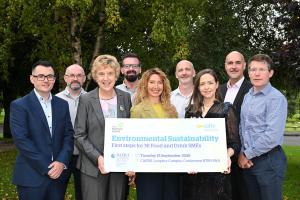
Delivered in partnership by CAFRE, DAERA’s Northern Ireland Food Strategy Framework team and Invest Northern Ireland, Environmental Sustainability: First Steps for Northern Ireland Food & Drink SMEs connected businesses with industry experience, specialist guidance and ongoing support.
Chaired by Joy Alexander, Deputy Director of DAERA’s Sustainable Agri-Food Development Division, the event supported sustainability, innovation and knowledge transfer by sharing good practice and helping businesses identify achievable environmental improvements.
Opening the event, Joy Alexander outlined the vision of the Northern Ireland Food Strategy Framework for an innovative food system that protects and enhances natural resources, is environmentally sustainable and supports economic ambition. Delegates heard how reducing energy, water, raw material use and waste can lower operating costs, respond to customer expectations and make businesses more resilient.
From measurement to practical action
Adrian Davis of AD Sustainability explored key areas for action, including energy, water, waste, raw materials, packaging and transport. He encouraged businesses to begin by establishing a baseline, identifying their most significant environmental impacts and prioritising manageable improvements.
His carbon-focused session helped delegates understand emissions data, calculate a baseline and identify realistic opportunities to reduce carbon and costs. Practical guidance also covered energy monitoring, equipment efficiency, renewable energy, waste segregation and resource optimisation.
Industry delegates received a carbon calculator to help put their learning into practice and begin measuring and understanding their emissions.
Learning from customers and food businesses
A retail and wholesale perspective was provided by James Waide and Aisling Vallely of Henderson Group. They highlighted changing supply-chain expectations and the growing importance of reliable sustainability and carbon data when responding to customer requests, tenders and reporting requirements.
Industry case studies demonstrated how sustainability can support innovation, efficiency and commercial performance. Connor McCann of Simplyfruit outlined how energy monitoring, heat recovery and solar generation had delivered practical improvements. He also showed how separating fruit waste streams created opportunities to turn off-cuts into higher value products.
Cathal McDonnell, Head of Business Transformation and Sustainability at Deli-Lites, described how sustainability had been integrated into the company’s purpose, operations and business planning. Its B Corp certification formed part of a wider journey encompassing energy and resource efficiency, food-waste reduction, responsible and local sourcing, employee involvement and community initiatives.
The Deli-Lites presentation included practical examples such as finding alternative uses for food off-cuts, redistributing surplus food, reducing the company’s freezer footprint and power requirements, and introducing solar panels and an air-source heat pump. It also addressed the commercial value of sustainability and challenges including Scope 3 emissions, greenwashing and changing reporting expectations.
Collaboration and business support
Jacqueline Gibson of International Synergies introduced the Resource Matching Service for Northern Ireland. The service helps businesses explore whether unused materials, by-products, equipment or capacity from one organisation could become valuable resources for another. This supports circular economy principles, business collaboration and reduced disposal costs.
Support and advice stands provided by Invest Northern Ireland, CAFRE, FareShare and International Synergies enabled delegates to engage directly with organisations offering business support, funding advice, resource-efficiency guidance, skills development, food-redistribution solutions and collaborative opportunities.
Delegates also valued the opportunity to network, exchange ideas and learn about practical measures that could be introduced within their businesses. Feedback from participants welcomed the practical focus of the presentations, the opportunity to learn from food businesses and the direct access to support organisations.
Reflecting on the event, Joy Alexander said: “What an inspiring event. All the speakers were highly motivational, providing genuinely practical insight, which should assist businesses on their sustainability journey.”
The event demonstrated that environmental improvement can begin with practical and manageable changes that also benefit business performance. Continued collaboration, knowledge transfer and follow-on support will help Northern Ireland’s food and drink businesses identify opportunities, take action and build long-term resilience towards net-zero targets.
A further in-person practical workshop is being planned for 28 October to help food manufacturing businesses continue their sustainability journey. Participants will receive hands-on support from a sustainability expert, including help with resolving issues when calculating carbon data using the carbon calculator and practical advice on establishing an effective sustainability plan.
Food manufacturing businesses interested in taking part should contact Dr Elaine McMackin by email: Elaine.McMackin@daera-ni.gov.uk to register their interest.
Notes to editors:
- Follow DAERA on X formerly called Twitter and Facebook.
- All media queries should be directed to the DAERA Press Office: pressoffice.group@daera-ni.gov.uk or telephone: 028 9016 3460.
Photo caption:
Speakers at the Packaging Policy update
Back row: Adrian Davis, Founder and Lead Consultant of AD Sustainability, Connor McCann, Operations Manager, Simply Fruit Ltd, James Waide, Energy Manager, Henderson Group, Peter Simpson, Head of Food Technology, CAFRE.
Front row: Cathal McDonnell, Head of Business Transformation and Sustainability, Deli-Lites (Ireland) Ltd, Joy Alexander, Deputy Director, Sustainable Agri-Food Development Division, DAERA, Jacqueline Gibson, Director for Northern Ireland, International Synergies, Aisling Vallely, Group Quality Assurance Manager, Henderson Group and Daniel Purdy, Energy and Resource Efficiency Manager, Invest Northern Ireland.