Students explore innovation and sustainability on study tour in England
Date published:
Level 3 Advanced Technical Extended Diploma in Agriculture (ATEDA) students from the College of Agriculture, Food and Rural Enterprise (CAFRE) recently travelled to England on a study tour, visiting a range of progressive farming businesses in the Lake District.
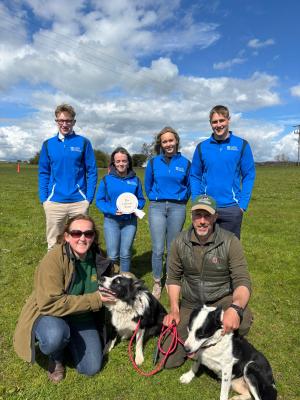
The study tour gave students the opportunity to see how modern farms combine productivity, sustainability, innovation and diversification, to remain competitive in a changing agricultural industry.
Miller Farming: Sustainability and diversification
The first visit was to Miller Farming in Penruddock, where Gary and Hazel Miller manage a mixed-farming enterprise spanning more than 250 acres. The business includes free-range laying hens, sheep, cattle, pigs and honey bees, with products sold through the farm’s own shop.
Students explored how diversified enterprises can maximise resources and create multiple income streams. They learned how animal welfare, environmental stewardship and sustainable land management are central to the Miller family’s approach. The business has also expanded beyond food production through educational farm tours and a successful farm shop, helping consumers gain a better understanding of food production.
Dry Howe Farm: The realities of upland livestock farming
The group then visited Dry Howe Farm near Kendal, a 1,900-acre hill farm operating in a challenging upland environment.
Students learned about the management of 150 Limousin cattle and 500 sheep, and how hardy livestock breeds and low-input systems help maintain profitability on marginal land. The visit highlighted the importance of careful breed selection in reducing housing and feed costs while supporting animal performance.
Students also gained insight into how sheep and cattle enterprises complement one another within extensive grazing systems. The visit demonstrated how successful hill farming relies on adapting management practices to suit the natural environment.
Pemberton's Farm Shop and Dairies: Connecting consumers with food production
On the second day of the tour, students visited Pemberton’s Farm Shop and Dairies, where they saw how innovation, direct marketing and strong community connections can strengthen a family farming business.
The visit began in the farm’s 14-point swing-over milking parlour, where students observed the technologies and management practices supporting efficient dairy production. They then toured the farm shop, which showcases a wide range of locally produced food. Students learned about the value of supporting local producers, reducing food miles and educating consumers about the origins of their food. Product sampling also highlighted the quality and freshness that can be achieved through short supply chains.
Brades Farm: Adding value through innovation
Later that day, the group visited Brades Family Farm, a 450-acre dairy enterprise with approximately 550 cows and a modern 26-point swing-over parlour.
A key focus of the visit was the farm’s use of Jersey genetics. Through careful breeding decisions, the business produces milk with higher butterfat and protein levels. This milk is marketed to the speciality coffee sector, where its quality enhances flavour, texture and performance in barista applications. Students saw how research, market awareness and product differentiation can help farms access premium markets and increase profitability.
Metcalfe Farms: Technology driving large-scale dairy success
The final visit was to Metcalfe Farms in Leyburn, a large-scale dairy enterprise spanning 3,000 acres and milking 1,300 cows.
Students observed advanced technology in operation, including a 72-point rotary parlour and robotic systems designed to improve efficiency and herd management. They also visited the farm’s biodigester, which generates renewable energy for the National Grid. The visit demonstrated how technology can improve productivity, animal health and labour efficiency while creating additional income opportunities and reducing environmental impact.
The study tour provided students with a valuable opportunity to experience the diversity of modern agriculture, and the different approaches farmers use to develop successful businesses. From sustainable mixed farming and upland livestock production to innovative dairy systems and renewable energy generation, each visit reinforced classroom learning through real-world examples.
CAFRE is grateful to The Gibson Trust for supporting the costs of the study tour for final-year Level 3 ATEDA students. The trip also gave students an opportunity to strengthen friendships before progressing to the next stage of their careers. Some will continue into higher-level study, while others will enter employment or return to family farming businesses.
If you, or someone you know is considering your options after GCSEs, CAFRE offers full-time and part-time courses in agriculture. For more information, please visit the CAFRE website.
Notes to editors:
- Follow DAERA on X formerly called Twitter and Facebook.
- All media queries should be directed to the DAERA Press Office: pressoffice.group@daera-ni.gov.uk or telephone: 028 9016 3460.