Tree Production and Planting in focus at CAFRE
Date published:
The College of Agriculture, Food and Rural Enterprise (CAFRE) hosted the second event in its Growers’ Gathering series, focusing on tree production and planting in Northern Ireland (NI).
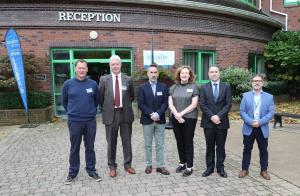
The event examined the current position of woodland creation and management, commercial forestry and tree seedling production, while exploring the challenges and opportunities facing the industry.
Key stakeholders gathered at CAFRE, Greenmount Campus, Antrim, for industry talks and updates, practical demonstrations and a lively Question and Answer session with the speakers.
David Dowd, Head of Horticulture, CAFRE welcomed the speakers and attendees to the event and thanked them for their continued support for collaboration across the sector.
Tree Planting Action Plan
Aoife Smith of the Forest Service opened the presentations with an overview of the current state of local woodlands which aims to increase Northern Ireland’s tree cover to 12% by 2050. She explained how the Tree Planting Action Plan (TPAP) aims to address key concerns and discussed the principal challenges and opportunities associated with afforestation.
National Trust: Roots to Recovery
Gregor Fulton, Woodland Adviser for the National Trust in NI, provided an update on the organisation’s ‘Roots to Recovery’ project. The latter encompasses tree nursery expansion, the creation of new woodlands, the restoration and restructuring of existing woodlands, and public engagement. He also explained how the National Trust contributes to the Tree Planting Action Plan and shared practical guidance on developing a cell-raised tree facility within Mount Stewart.
Commercial forestry
John Hetherington from Premier Woodlands, a forestry investment and management company based in Cookstown gave a presentation which highlighted the limitations affecting timber production in NI and the main barriers to further growth. He also outlined ways for the industry to address these issues by focusing on end users for forestry products when making planting decisions and building on the strengths of the quality of our products.
Future tree planting
Dr Rodrigo Olave from AFBI explored the challenges that climate change poses for current silvicultural practices. He discussed how artificial intelligent tracking tools and the consideration of new tree species could support effective long-term mitigation while addressing environmental and productivity concerns.
Accelerated tree seedling production
CAFRE’s Senior Horticulture Technologist, Dr Konstantinos Xyntaris addressed the need for rapid, large-scale tree seedling production. He explained the benefits of air-root-pruning technology and its use in producing cell-raised trees to shorten production times and accelerate early growth. He also discussed seedling quality and production costs.
Practical demonstrations
Following the morning presentations, attendees visited the Horticulture Centre at Greenmount Campus to review advances in cell-raised tree production.
The demonstrations were led by CAFRE Horticulture Technology staff Dr Konstantinos Xyntaris and Mark Huey.
From bare-root to cell-grown trees
Mark Huey, CAFRE Horticulture Technologist, outlined the transition from bare-root to cell-grown tree production in the UK over the past 30–40 years. He began by describing the demanding production requirements for high-quality bare-root trees, which can be difficult to meet in NI. He then explained how cell-grown production has addressed many of these limitations and how tray designs have evolved to improve root quality. Mark also introduced mini-plug systems, which improve space efficiency and maximise the use of valuable seed, particularly clonal forestry seed stocks.
Air-root pruning demonstration
Dr Xyntaris demonstrated how air-root-pruning can be applied at different cell depths and intensities and explained its influence on tree seedling growth during germination and subsequent grow-on stages.
Key messages
Key messages from the event underscored both the significant challenges and the considerable opportunities facing the industry. A central theme was the importance of sustaining and strengthening Northern Ireland’s established skills base, with optimism that the forthcoming CAFRE Level 4 Arboriculture course will play a pivotal role in developing the next generation of industry professionals.
Speakers emphasised the need for future forestry plans to be guided by end-user requirements while remaining resilient and environmentally appropriate in the face of climate change. There was also a clear call for greater collaboration across all sectors of the Northern Ireland forestry and tree production industry to drive innovation, share expertise, and address common challenges. Events such as this are vital in fostering meaningful dialogue, strengthening partnerships, and aligning industry practice with policy and legislative objectives.
Looking ahead
The Horticulture Technology Team at CAFRE is planning further events and courses for industry professionals throughout 2027. For updates, visit the events section of the CAFRE website.
Notes to editors:
- Follow DAERA on X formerly called Twitter and Facebook.
- All media queries should be directed to the DAERA Press Office: pressoffice.group@daera-ni.gov.uk or telephone: 028 9016 3460.