Using genetic information to deliver results
Date published:
“When it comes to breeding genotyping gives me more confidence that I am selecting the right bulls to cross with the right cows.’’ This was a comment made by James Orr who farms along with his father William near Ballintoy in Co Antrim.
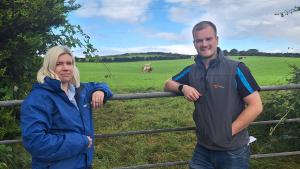
Together they have a suckler herd of around 100 cows, mainly Limousin x Simmental cross with some Belgian Blues and Charolais as well.
The herd is split calving with most cows calving in August and September which reduces incidences of scour and allows for easier fertility management with cows being artificially inseminated when they are housed. The remainder of the cows are spring calving and are bred with a Charolais bull that carries the F94L myostatin gene for double muscling. William has always been keen to breed a milky cow as this gets the calf off to a good start. For this reason, his cows are mainly of a rotational Simmental x Limousin cross where the Simmental is renowned for its milkiness and the Limousin it’s carcass characteristics.
William and James took part in the pilot of the Bovine Genetics Project with Sustainable Ruminant Genetics (SRG) last year when they genotyped just over half their cows as well as the replacement heifers. A report was produced for each animal which identified the breed makeup of the cows and heifers that were genotyped together with details on their sire and dam. One of the things that interested James most was the genetic report which gave the myostatin status of each animal, letting him know whether animals carried 0, 1 or 2 copies of the various myostatin genes. When James saw the myostatin results for each cow he could relate this to their physical appearance, with the beefier cows in his herd carrying a copy of the F94L gene. Six of his cows carried two copies of the F94L myostatin gene and over 30 cows had one copy. Four cows carried one copy of the Q204X gene. James was also interested in carriers of the polled gene, which is dominant over the horned condition, something that will be useful from a management point of view and identifying whether a calf is likely to have horns or not.
One of the most useful reports for a suckler cow producer is the beef calving report which for William and James’ herd showed that their cows had an average calving interval of 378 days in the previous year based on NIFAIS recorded birth events - 24 days shorter than the Northern Ireland suckler herd average of 402 days. This report also gives details on the number of cows that calve each month and the percentage of cows that calve in the first six weeks of the calving season, whether that be spring or autumn, or in William and James’ case, both. The report also gives the percentage of ‘recycled cows’ which is the proportion of cows that do not go in calf and are carried over from one breeding season to the next.
This year, James proposes to inseminate 25 cows with sexed Simmental semen and all his replacement heifers with sexed Limousin semen from high index sires of moderate stature to avoid breeding large cows with a high maintenance value. James has been using sexed semen for the last few years, breeding his replacements from his best maternal-type cows. The rest of his herd will be served with a Limousin sire with good growth and carcass trait characteristics. Armed with genetic information this year on double muscling, he plans to match sires to individual cows to avoid situations that are likely to result in more difficult calvings.
Sustainable Ruminant Genetics will be publishing genetic information for all animals that are genotyped on their user portal (www.srgni.com). In 2027, a Maternal Index will be available to identify the best animals to breed suckler cow replacements and a Terminal Index to identify the best sires to breed beef animals for slaughter. A Commercial Beef Value (CBV) index will also be available to allow a comparison of commercial beef cattle across all breeds, irrespective of whether they are of dairy or beef origin.
To encourage uptake of genotyping and improve the genetic merit and production efficiency of the beef production in Northern Ireland, genotyping is being supported by the Northern Ireland Bovine Genetics Genotyping Scheme. This scheme opened on 1 September 2026 for the genotyping of current and future breeding stock (cows, heifers and bulls) with the genotyping of all calves, male and female, opening on 1 January 2027. The additional tags and genotyping will cost farmers £13 per animal. This cost is being covered by DAERA through the Bovine Genetics Genotyping Scheme.
For information on how to register for the Bovine Genetics Project and access genotyping for your herd visit: www.srgni.com, contact SRG at telephone 028 2046 2280 or contact your approved tag supplier.
Notes to editors:
- Follow DAERA on X formerly called Twitter and Facebook.
- All media queries should be directed to the DAERA Press Office pressoffice.group@daera-ni.gov.uk or telephone: 028 9016 3460.