Efficient suckler production to be discussed at Beef Conference
Date published:
The key factors influencing a productive suckler cow system, achieving both economic and environmental sustainability, will be discussed at the upcoming College of Agriculture, Food and Rural Enterprise (CAFRE) and Ulster Farmers’ Union (UFU) Beef Conference.
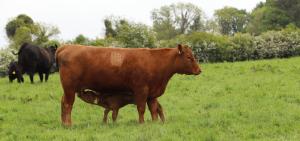
Martin Kirk, CAFRE, Beef and Sheep Technologist, comments: “Optimising productivity of a suckler cow system is achieved through several key management decisions. These include fertility and breeding, replacement heifers and animal health management.”
These areas will be discussed during the CAFRE/UFU Beef Conference on Wednesday 10 June 2026, at CAFRE Greenmount Campus; Driving productivity, delivering sustainability – Achieving economic and environmentally sustainable beef systems.
Fertility and Breeding Management
“The CAFRE lowland suckler herd is composed of 100 spring calving, Stabiliser bred cows. The focus of the herd is to breed moderate sized, efficient cows, producing replacement females with improved genetic potential, good fertility and high health status, alongside a beef animal with good growth potential on a forage-based system”, commented Kirk.
At turnout, cows and calves are batched to establish breeding groups for the upcoming season. With approximately 30 cows per group, animals are identified for breeding with Stabiliser bulls or artificial insemination (AI) with terminal sires. Replacement heifers are bred via AI, with a focus on easy calving sires with maternal genetic traits.
Breeding lasts ten weeks, commencing in mid-May, resulting in a compact calving period, with replacement heifer breeding beginning two weeks before the mature cows, currently the herd is achieving a calving interval of 371 days.
A key herd performance indicator is cow efficiency. Cow efficiency is expressed using the calf’s weaning weight as a percentage of the cow’s mature body weight. The target is for each cow is to wean a calf 40-45% of her mature weight. The CAFRE herd average is currently 41%, based on mature cow weight of 680 kg and a 200 day calf weight of 278kg.
Mothering ability, cow temperament, teat and udders and milk yields are also monitored and scored at the point of calving, and throughout the year. These records are used when selecting cows for breeding the following season.
Replacement Heifer Management
With replacements being home bred, good record keeping is essential to ensure animals are selected on their genetic merit, expressed in terms of growth but also including maternal calving ease, temperament and previous cow efficiency calculations of their dams.
These farm records will be further enhanced by a recent genotyping exercise for the breeding females. The resultant genomic evaluations will be a driver in animal selection, informing management decisions and improving the speed of herd genetic gain.
To achieve an age at first calving of 24 months, growth and development is monitored from birth, animals need to achieve an average daily liveweight gain of 0.8kg/day to reach the target of 60-65% of their mature weight at first service and 80% of mature weight at calving. CAFRE heifers calve down at an average of 24.1 months of age.
This year, replacement heifers have been given two rounds of AI under a fixed time AI protocol. Females not selected for breeding, or those not in calf after breeding move into the beef heifer group.
Animal Health Management
Health planning is an important area in driving suckler cow productivity and profitability. CAFRE herd health is managed using a vet derived animal health plan. This plan is reviewed annually, or as a disease challenge requires, providing a structure for all health-related management practices in the herd. Based on the herds previous year’s health performance, vaccination programmes are agreed based on current disease challenges and potential risk.
The use of antibiotics is managed by a series of Standard Operating Procedures (SOPs) which inform management decisions prior to antibiotic use; ensuring antibiotic is only used when required.
Parasite control and anthelmintic use is also agreed based on a pre and post treatment, for parasite burden, testing plan.
A proactive approach to health planning minimises loses in production while also ensuring responsible use of antibiotics and anthelmintics
Beef Conference
To hear more about the CAFRE suckler system, come along to the Beef Conference on Wednesday 10 June at Greenmount Campus, Antrim. The conference runs from 9:30am to 5:00pm, with a technical session of industry expert speakers followed by the farm visit after lunch. If you are unable to attend the conference during the day, the farm tours will be held again in the evening from 6:00pm to 7:30pm.
More information and to register to attend.
Notes to editors:
- Follow DAERA on X formerly called Twitter and Facebook.
- All media queries should be directed to the DAERA Press Office: pressoffice.group@daera-ni.gov.uk or telephone: 028 9016 3460.