Blue-Green Algae Frequently Asked Questions
Find out more about Blue-Green Algae, including what causes it and what to do if you come across it in our waterways or at our beaches.
What is Blue-Green Algae?
Blue-Green Algae, also called cyanobacteria, are microscopic organisms that occur naturally in lakes and rivers. Often they are harmless, but a build-up of Blue-Green Algae can make the water unsafe for people and animals by releasing potentially harmful toxins.
What causes Blue-Green Algae?
The following all have a role in contributing to the increase in Blue-Green Algae blooms on our waterways:
- Nutrient Pollution (excess phosphorus and nitrogen) entering our waterways from agriculture, wastewater treatment works, domestic systems and industry.
- Climate change resulting in record high water temperature.
- Zebra mussels, an invasive species known to disrupt ecosystems by impacting water clarity.
Find out more about what causes Blue-Green Algae in this video from Lough Neagh Partnership Perspectives on Lough Neagh: Blue-Green Algae.
What time of year is Blue-Green Algae present?
Algal blooms can occur throughout the year, but they are most common from May through to September when suitable weather conditions combine with a ready supply of nutrients.
Is Blue-Green Algae harmful?
Blue-Green Algae poses risks to public and animal health when they form blooms and scums in warm summer and autumn months, due to the toxins they produce.
Symptoms of exposure may include skin rashes, fever and headache, stomach pains, nausea, vomiting or it may occasionally lead to more serious symptoms such as liver and brain damage. Pets may experience drooling, diarrhoea, increased thirst, vomiting, seizures, breathing difficulties and in extreme cases death.
You should follow guidance on posted signs and rinse yourself and your pets with tap water if you have been in the water. Don’t let pets drink lough, lake, river or stream water or eat algae or lick it off their fur.
Blue-Green Algae can also be harmful for farm animals. If you see scummy or discoloured water, protect your animals by keeping them from drinking or going into the water or eating near the water.
How can I identify Blue-Green Algae?
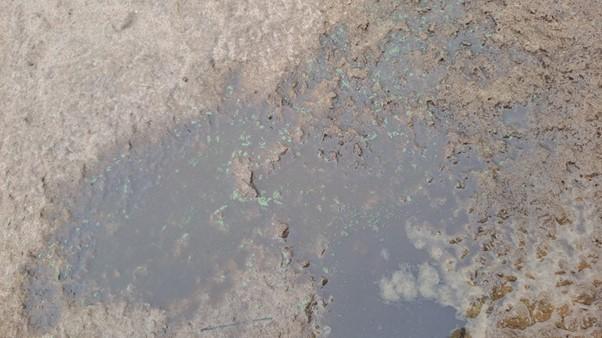
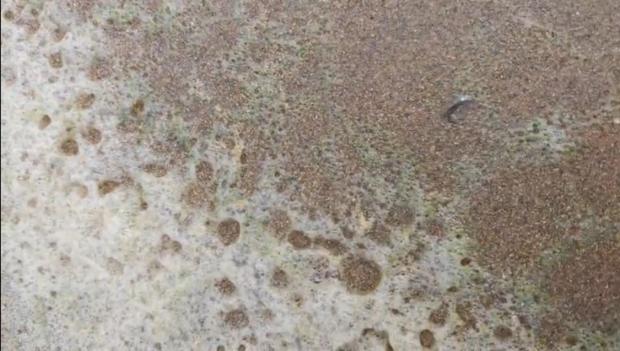
During a Blue-Green Algae bloom, the water becomes less clear and may look green, blue-green or greenish-brown. Scums can form along shorelines when bloom forming species rise to the surface. This can look like paint, mousse or small clumps.
Where Blue-Green Algae has been transported to the marine environment, it can look like glitter in the water or like clumps where it is washed onto the beach. It may also appear as a green coloured tide mark on the sand on the shoreline, green clumps in seafoam, green coloured foam or in blue-green tide pools. The duration of blooms may last for a few days to several weeks until conditions in the waterbody change and the algae die and decompose.
Some examples of how Blue-Green Algae can look when it reaches a beach are below:
Some further examples of what Blue-Green Algae can look like are available at What is Blue-Green Algae? | Department of Agriculture, Environment and Rural Affairs.
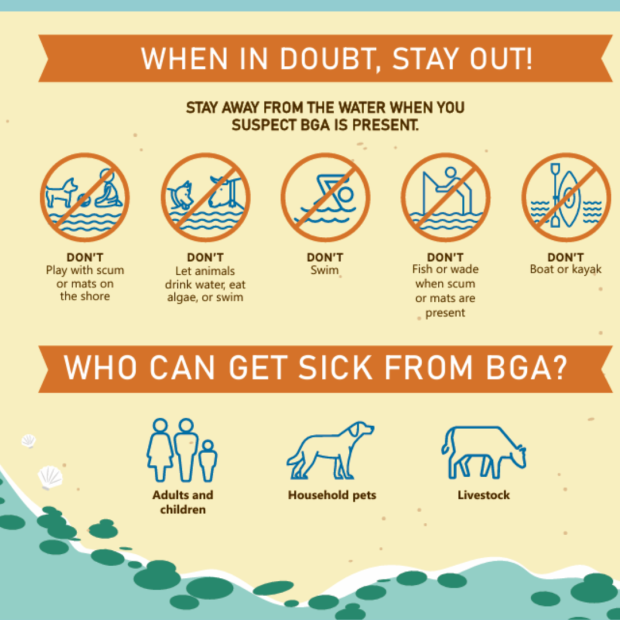
Download a Blue-Green Algae infographic with guidance on how to identify Blue-Green Algae and what to do if you suspect Blue-Green Algae is present in water Blue-Green Algae Infographic | Department of Agriculture, Environment and Rural Affairs.
What should I do if I suspect Blue-Green Algae?
You should stay away from water where Blue-Green Algae is present. You shouldn’t let animals drink water, eat algae or swim and you shouldn’t enter the water to swim, to wash or for boating or other leisure activities such as kayaking and paddle-boarding.
Anglers also need to be extremely careful because of the risks of handling fish and equipment. The advice is that anglers do not fish or wade when Blue-Green Algae scum or mats are present.
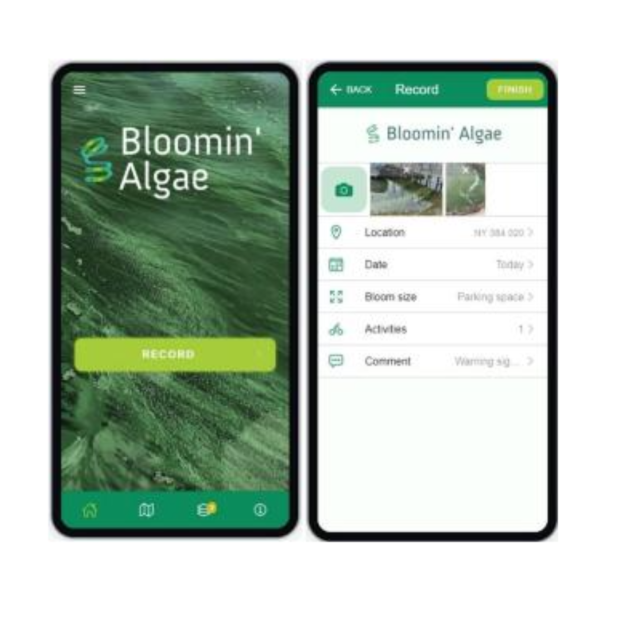
You should use the Bloomin’ Algae app to report potential sightings of Blue-Green Algae. You will need to record the location and date, as well as submit some photos to help verify the record.
You may also report possible Blue-Green Algae by phoning the NIEA Incident Hotline on 0800 80 70 60 (this is available 24 hours a day, 365 days a year) or emailing emergency-pollution@daera-ni.gov.uk.
What happens if I submit a sighting of Blue-Green Algae?
Records submitted either by email, through the NIEA Incident Hotline or using the Bloomin’ Algae app will be verified by Northern Ireland Environment Agency scientists. If needed, experts will look at the types of Blue-Green Algae in a sample to help confirm whether a bloom is actually present. Visual inspections of the water will be carried out for evidence of bloom and scum formation.
What should I do if I have come into contact with Blue-Green Algae?
If you think you may have been in contact with water contaminated with Blue-Green Algae, you should shower immediately. If you become unwell, you should seek immediate medical advice.
If your pet has come into contact with Blue-Green Algae you should contact your vet immediately as dogs can become unwell very quickly – in as little as 15 minutes after being exposed to Blue-Green Algae.
How can I find out if Blue-Green Algae is in water near me?
You can see confirmed locations of Blue-Green Algae in Northern Ireland using the Blue-Green Algae Location Viewer, available at Blue-Green Algae - Confirmed Locations.
Can I swim in water with Blue-Green Algae?
No. If you suspect Blue-Green Algae may be present, stay out of the water and keep pets out too. Blue-Green Algae can produce toxins that are harmful to people and animals.
If Blue-Green Algae is identified in a bathing water, DAERA worked with all the statutory authorities to develop an Inter-Agency Blue-Green Algae Monitoring Protocol. Under the Protocol, and where Blue-Green Algae is present at significant levels in a bathing water, DAERA will inform the bathing water operator (the organisation who is responsible for the site e.g. the local Council or National Trust for Portstewart) that Blue-Green Algae is present. If levels breach safety thresholds, an ‘advice against bathing’ notice will be issued on social media and in the press. In addition, the bathing water operator will put signs up at the site to advise people not to go into the water.
An online Northern Ireland Bathing Water Dashboard provides recent water quality results for the 33 identified bathing waters across Northern Ireland. The information in the dashboard is designed to help you make informed decisions before entering the water during bathing water season (1st June to 15th September).
In other waterbodies, that are not one of the 33 identified bathing waters, It is recommended that regular visual inspections of the water are made by the site owner / operator, for evidence of bloom and scum formation. Site owners / operators are responsible for putting up signage and restricting access if Blue-Green Algae is present. Signage is available from DAERA if required.
Even if there is no signage at a location, should the appearance of a water body concern you, when in doubt, stay out, and do not let pets swim in, play in or drink water that looks discoloured or has scum on the surface.
Is my water safe to drink?
Blue-Green Algae can produce naturally occurring organic compounds which can give an earthy or musty smell and taste to water, even after going through the water treatment process. These organic compounds are not harmful to health and the drinking water is safe to use as normal.
NIEA’s Drinking Water Inspectorate regulates the quality of the drinking water supply provided by NI Water.
Anyone with any concerns about their public drinking water supply should contact Waterline on 03457 44 00 88 or on waterline@niwater.com.
How can I find out where my water comes from?
Use the postcode search available on the NI Water website at https://www.niwater.com/current-service-updates/.
Who does what with regard to Blue-Green Algae in Northern Ireland waterways?
A number of organisations have a role to play with regard to Blue-Green Algae:
Department of Agriculture, Environment and Rural Affairs (DAERA)
DAERA monitors 33 identified bathing waters for Blue-Green Algae blooms, including toxins, to protect bathers’ health. DAERA staff will inform bathing water operators of incidents of Blue-Green Algae in bathing waters.DAERA’s Veterinary Science and Animal Health Group is responsible for advising and acting upon animal health issues.
- Northern Ireland Environment Agency (NIEA)
NIEA is responsible for identifying and confirming the presence of Blue-Green Algae blooms reported through the Bloomin’ Algae App or the NIEA Incident Hotline. NIEA is responsible for informing bathing water operators, Local Council Environmental Health Departments and NI Water of any confirmed blooms where possible. NIEA also undertakes a programme of water quality monitoring to report upon the ecological health of our water environment. - Food Standards Agency (FSA)
The FSA provides advice to food businesses and consumers on the safety of consuming fishery products from water bodies affected by Blue-Green Algae blooms. - Public Health Agency (PHA)
The PHA provides specialist advice and guidance relating to the health of the public in Northern Ireland. - Local Council Environmental Health
Local Councils’ Environmental Health teams are responsible for providing advice to waterbody owners and the public regarding public health issues in their council area. They provide advice to local councils on health and safety for recreational water and waterside users. - NI Water
NI Water is responsible for providing all public water and sewerage services in Northern Ireland. NI Water has to meet regulations set out in law when supplying water for domestic or food production purposes. - Drinking Water Inspectorate (DWI)
The Drinking Water Inspectorate (DWI), within NIEA, regulates the provision of drinking water by NI Water to ensure the protection of public health. DWI independently assesses the quality of the public drinking water supply to provide reassurance that the water is safe to drink. - Water Business Owners / Controllers
Water businesses are responsible for warning and advising users of any potential dangers of their waterways. This requires liaising with local councils and PHA on public health related issues.
What is being done to address the Blue-Green Algae situation?
‘Protecting Lough Neagh and the Environment’ is one of the nine key priorities for the Northern Ireland Executive, set out in the Programme for Government. The Department of Agriculture, Environment and Rural Affairs (DAERA) Corporate Plan also pledges to ‘have delivered improvements to water quality, including through implementation of the Lough Neagh Action Plan and other interventions’ by 2027.
The Lough Neagh Report and Action Plan, which was approved by the Executive in July 2024, sets out 37 actions around the four pillars of: Education; Investment; Regulation and Enforcement. Most of the actions are the responsibility of DAERA, with the Department for Infrastructure and the Department of Justice involved in a small number of actions.
Implementation of the plan is progressing with 20 actions having been delivered and 17 progressing (as of March 2026).
How long will it take for Lough Neagh to recover?
The issues of Blue-Green Algae are as a result of what happens in Lough Neagh’s entire catchment area, which includes a large part of Northern Ireland, as well as areas of the Republic of Ireland. These issues have been decades in the making, and many of the actions identified to help Lough Neagh recover are long-term projects, which may take decades to lead to measurable improvements.
Find out more about some of the potential nature-based solutions that can benefit water quality, as well as some of the important research into innovative solutions to the Blue-Green Algae issue in this video from the Lough Neagh Partnership Perspectives on Lough Neagh: Blue-Green Algae.
What can I do to help improve water quality?
Simple steps can help deliver improvements in local water quality, which, in turn, can help Lough Neagh and other water bodies to begin to recover. Some things that householders can do include the following:
Stop and think – not down the sink
• No oil, fat or grease down the sink or drain
• Don’t scrape food into the sink
• Don’t use boiling water to dissolve fat and grease.
Know your drains and prevent misconnections
• Check your plumbing to make sure your wastewater (including from appliances) is going to the right drains. Incorrect plumbing can cause pollution.
• Only rain should go down your outside surface drains!
Ensure correct disposal of chemicals, paints, fats and oils
• Don’t pour waste fats, oils and grease down drains or into sewers - find out more about this at Fats, Oil And Grease (FOG) - Northern Ireland Water.
• Dispose of chemicals, paints and used cooking oil at household waste recycling centres.
Look after your septic tank to keep it healthy
• Make sure it’s properly serviced.
• You need a consent from the Northern Ireland Environment Agency. You can search the Domestic Consent Public Register to check if your property has a consent (all domestic consents and maps for consents granted from 1992 to present are available to download).
• If your property does not have a Domestic Consent, you can apply online at Applying for a Domestic Consent.
• Get it desludged regularly – Northern Ireland Water provide a free desludging service (once every 12 months, provided service conditions are met) Arrange Septic Tank Emptying - Northern Ireland Water.
Car wash care
Preferably wash your car at a dedicated facility but if washing at home make sure that soapy water doesn’t go into storm drains that lead to rivers.
Prevent litter
• Litter can get washed into storm drains and directly into our waterways harming wildlife, including birds and fish and decreasing the oxygen levels in the water when it decays.
Limit chemical and pesticide use and disposal
• Never allow entry of chemicals or pesticides into any water system including drains, sinks, toilets, waterways, ditches
• Don’t put chemicals or pesticides in your bin unless the label says you can
• Don’t put chemicals or pesticides on a garden bonfire
Don’t flush it, bag it and bin it
• Only the 3 Ps – pee, poo and paper should go down the toilet – any other waste (such as sanitary items, nappies, wipes, cotton buds) can cause blockages, and should be bagged and binned hygienically. Find out more at Bag it And Bin it - Northern Ireland Water.