Ambitious new All-Ireland Pollinator Plan aims to create ‘pockets for nature every 200 metres’
Date published:
A new five-year plan brings together communities, farmers, businesses, and public bodies to create a more biodiversity-rich landscape.
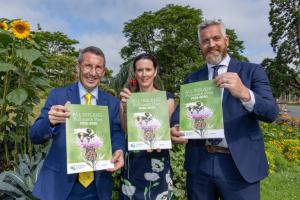
The new All-Ireland Pollinator Plan 2026-2030 was launched today [9 July] at the National Botanic Gardens, Dublin, by Andrew Muir MLA, Minister for the Department of Agriculture, Environment and Rural Affairs (DAERA), and Christopher O’Sullivan, Ireland’s Minister of State at the Department of Housing, Local Government and Heritage.
The All-Ireland Pollinator Plan is a voluntary framework coordinated by the National Biodiversity Data Centre and supported by a wide network of partner organisations across both jurisdictions, with the Northern Ireland Environment Agency leading in Northern Ireland. This 2026-2030 phase of the Pollinator Plan is supported through funding from the Government of Ireland’s Shared Island Fund, the National Parks and Wildlife Service, the Department of Agriculture, Food and the Marine, and the Department of Agriculture, Environment and Rural Affairs (DAERA).
In his launch address, DAERA Minister, Andrew Muir said: “Bees, butterflies and our other pollinators are the unsung heroes of our environment, playing a fundamental role across our ecosystems. The All-Ireland Pollinator Plan provides a clear, practical framework to support these busy bugs in enabling nature recovery. By working together, across all landscapes, it is possible to restore pollinator populations and create an island that is richer in biodiversity, more resilient to climate change, and better for people and nature alike.”
The All-Ireland Pollinator Plan is fundamentally a collective effort. Its success depends on the voluntary participation of farmers, organisations, communities, and individuals who commit to implementing actions within their own areas of influence. They enable plant reproduction, support biodiversity, and underpin agricultural productivity and food security. However, wild pollinators, including over 100 wild bee species, are in decline due to habitat loss, climate change, and pollution (pesticide use). One-third of bee species on the island of Ireland are at risk of extinction. Therefore, addressing pollinator decline is both an ecological necessity and a societal priority.
The vision of the All-Ireland Pollinator Plan 2026–2030 is simple but ambitious: to create a landscape that provides food and shelter every 200 metres, where pollinators can survive and thrive. This mission reflects that our important solitary bees can only travel these short distances from their nest sites to find food. Achieving this vision will require coordinated action across all land types, supported by strong partnerships and public engagement.
Since its inception in 2015, the All-Ireland Pollinator Plan has become internationally renowned as best practice, and as successful model that has been copied by other European States in developing their own action plans to reverse pollinator declines. The Plan is built on robust scientific research, and all recommended actions are evidence-based.
Dr Sara McGuckin, Head of Natural Science in NIEA said: “Halting and reversing pollinator species decline is essential to securing healthy, resilient ecosystems and sustainable food systems. NIEA is delighted to continue our strong partnership through the All Ireland Pollinator Plan to 2030. By strengthening our monitoring of pollinators, we can develop a better understanding of what our rare and threatened species need and track recovery of pollinator populations across Ireland.”
In a time of climate and biodiversity anxiety, the All Ireland Pollinator Plan empowers people to create positive change for our future and provides all the knowledge and tools to allow anyone to take action for biodiversity.
Its ethos is simple: ‘small actions, taken together, can create real change - helping to restore pollinators in order to build a healthier, more resilient environment for everyone.’
Notes to editors:
1. Photo caption - Today, July 9th, the new All-Ireland Pollinator Plan 2026-2030 was launched at the National Botanic Gardens, Dublin, by Andrew Muir, Minister of Agriculture, Environment and Rural Affairs, Northern Ireland and Ireland’s Minister for Nature, Heritage and Biodiversity, Christopher O’Sullivan TD. Pictured with Dr Úna FitzPatrick, Co-founder of the All-Ireland Pollinator Plan and Chief Scientific Officer, National Biodiversity Data Centre.
2. The All-Ireland Pollinator Plan 2026–2030 is a coordinated, evidence-based framework that brings together organisations, communities, businesses, and individuals across the island of Ireland to address the decline of pollinating insects. It builds on the strong foundations of the first two phases (2015–2020; 2021–2025), which successfully mobilised cross-sectoral action and delivered measurable progress through 267 actions to date.
3. The All-Ireland Pollinator Plan was initiated by Dr Úna FitzPatrick (Chief Science Officer, National Biodiversity Data Centre) and Prof. Jane Stout (Trinity College Dublin) in 2015 and has since received international recognition as an exemplar in best practice and as a conservation success story.
4. Since its launch in 2015, the All-Ireland Pollinator Plan has grown into a widely recognised and successful initiative. Achievements to date include:
- Delivery of all actions in previous plans
- Engagement with over 120 partner organisations across multiple sectors
- Development of extensive free, evidence-based guidance and training resources
- Participation of all 42 local authorities on the island
- Engagement of over 400 businesses and hundreds of community groups
- Establishment by the National Biodiversity Data Centre of national monitoring schemes
- Logging of over 14,000 pollinator-friendly actions from across the island through a public mapping system
5. There is very strong public support for pollinator conservation, with polls showing the majority of people recognise the importance of pollinators, and express willingness to take action.
6. Despite this progress, pollinators remain under significant pressure. The 2026–2030 Plan therefore seeks to scale up action, deepen engagement, and better connect efforts across sectors and landscapes.
7. Pollinators are central to functioning ecosystems, resilient landscapes, and sustainable food systems. Their decline signals wider environmental challenges but also presents an opportunity for collective action that results in wider biodiversity and societal benefits.
8. The All-Ireland Pollinator Plan 2026-2030 includes 50 strategic aims and 75 success metrics, which will be reported annually to ensure accountability and transparency. Its 10 work packages cover key sectors such a Farmland, Public Land, Transport Networks, Communities, and Businesses. Together, these work packages aim to drive landscape-scale change, connecting individual actions into a coherent ecological shift towards an island where pollinators can survive and thrive.
9. To find out more about the All-Ireland Pollinator Plan, please see: pollinators.ie
10. Follow DAERA on X formerly called Twitter and Facebook.
11. All media queries should be directed to the DAERA Press Office: pressoffice.group@daera-ni.gov.uk or telephone: 028 9016 3460.
12. The Executive Information Service operates an out of hours’ service for media enquiries only between 1800hrs and 0800hrs Monday to Friday and at weekends and public holidays. The duty press officer can be contacted on 028 9037 8110.