The Dairy Cow’s Supplement
Date published:
In this article, Matthew Murnion, a Dairy Adviser with the College of Agriculture, Food and Rural Enterprise (CAFRE) focuses on meeting the cows’ energy requirements at grass and appropriate supplementation strategies for your herd.
Realistic expectations of grass intakes
Grass quality is consistently high year on year in early first grazing. Typically grass quality ranges between 11.5-12.0 MJ/kg Dry Matter (DM) throughout the season. The Grasscheck Bulletin is always a good reliable source of grass growth and quality information for your general area.
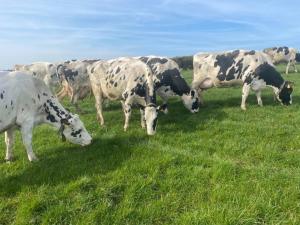
Philip Truesdale, Business Sustainability Group member comments on his herd grazing on 15 March 2026 at Ballyward: “Cows always perform well on early grazed grass, it’s a real good feed. Getting out early for us means we can both lower feed costs and establish the grass wedge on the farm, basically sets up the farm for top quality grass all year.”
Table 1: Greenmount Campus - Fresh Grass Analysis (taken 16 March 2026)
| Grass Sample | Result |
| Dry Matter (DM)% | 19 |
| Crude Protein (CP) % | 28.7 |
| Metabolisable Energy (ME) MJ/kg DM | 12.4 |
Table 1 shows the sample had an extremely high CP and ME level, which with difficult grazing conditions and some silage still in the diet, can make grass intake calculations a real challenge on farms. In ideal conditions dairy cows will achieve Dry Matter Intakes (DMI) of 3–3.5% of bodyweight. For most cows this equates to 18-20 kg DM per day. Using these parameters and actively measuring and monitoring grass intakes daily can pay dividends for your herd. Ensuring cows are accurately fed to meet the dietary demands of production and cow maintenance should be a primary focus for all dairy producers.
Meeting the demand
Table 2 highlights the variation in energy required to produce one litre of milk at various milk fat and protein levels. Meeting the energy demand for cow maintenance and production must be monitored closely.
Table 2: Energy requirements - Butterfat and Protein levels MJ/litre
| Protein % | ||||||
| Fat % | 3 | 3.2 | 3.4 | 3.6 | 3.8 | 4 |
| 3.8 | 5.1 | 5.2 | 5.3 | 5.3 | 5.4 | 5.5 |
| 4 | 5.3 | 5.3 | 5.4 | 5.5 | 5.5 | 5.6 |
| 4.2 | 5.4 | 5.5 | 5.5 | 5.6 | 5.7 | 5.7 |
| 4.4 | 5.5 | 5.6 | 5.7 | 5.7 | 5.8 | 5.9 |
| 4.6 | 5.7 | 5.7 | 5.8 | 5.9 | 5.9 | 6 |
| 4.8 | 5.8 | 5.9 | 5.9 | 6 | 6.1 | 6.1 |
Table 3 illustrates the energy calculation needed for your herd, taking account of cow liveweight, stage of lactation and milk production, including milk components. Milk solids coincide with increased genetic improvements which need to be factored into energy supplied in the cow’s diet.
Table 3: Energy Demand and Supply for a full-time grazing 30l Dairy Cow (4.4% fat & 3.6% protein)
| Energy Demand | Assumptions | Calculation | MJ required |
| Cow maintenance | 630kg liveweight | 10% BW + 10MJ | 73MJ/day |
| Milk yield | 30l @ 4.4%BF & 3.6%pro. | 5.7MJ/litre of milk | 171MJ/day |
| 244MJ | |||
| Energy supply | |||
| Grass intake | 17kgDM/day | 12MJ/kg DM | 204MJ/day |
| Meal supplement intake | 5kgDM | 11.5MJ/kg DM | 56MJ/day |
| 261MJ |
Topping up with Purchased Concentrate
Pre grazing grass cover is the single best measure to ensure top quality grass is available for cows daily. Maintaining pre grazing covers at 2,900-3,000 kg DM/ha is the optimal growth stage for grass to be grazed, from a nutritional perspective you will achieve maximum leaf and minimal stem content, thus high levels of digestibility. Cows can remove 18-20 kg DM/day but grass quality needs to be on target, and as herd managers your allocation must be correct, don’t hold the herd back in the paddock. Focusing on pre grazing cover will automatically deliver the correct residual grass cover, cows will achieve the desired residual if the pre grazing is correct. Using various techniques mentioned in other sections of this grass and grazing series maintaining a pre grazing cover can be achieved, as the season continues other methods like removing paddocks which exceed the 2,900-3,000 kg DM cover will help.
The example in Table 3 is based on a 630kg cow/140 days in milk/producing 30 litres per day at 4.4% butterfat and 3.6% protein. Maintenance energy requirements are estimated at approximately 73 MJ/day (10% of bodyweight + 10 MJ). Assuming an energy requirement of 5.7 MJ per litre of milk produced this cow has an energy demand both production and maintenance of 244 MJ/day. Energy from grazed grass will go towards meeting this demand, even using a more conservative grass energy of 12 MJ/kg DM and the cow eating 17 kgs of grass dry matter a concentrate supplement will be required. Table 3 illustrates with a supplement level of 5 kgs the energy requirements of this cow will be slightly over supplied.
Achieving this all hinges on good management, correct pre grazing covers and targeted allocation of concentrates all supplying desired energy levels.
This is a supplementary article for the two-part series on ‘Building your farm resilience with grass and grazing’ which focused on modern techniques and tools dairy producers use to capitalise on grazed grass, why it’s considered a competitive advantage for Northern Ireland producers and how best to grow grass. You can read these previous articles at the news section of the CAFRE website.
Notes to editors:
- Follow DAERA on X formerly called Twitter and Facebook.
- All media queries should be directed to the DAERA Press Office: pressoffice.group@daera-ni.gov.uk or telephone: 028 9016 3460.