Dutch dairy breeding innovations inspire local farmers
Date published:
‘Great trip, well organised and plenty learned’ was one statement from a group of 18 dairy farmers from across Northern Ireland who visited the Netherlands to examine innovations in dairy cattle breeding.
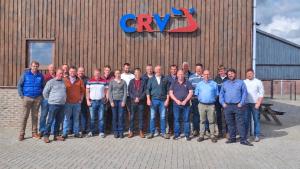
The Innovation Visit coincided with the launch of the Bovine Genetics Project (BGP) and was funded through the Innovation Scheme, part of the Department of Agriculture, Environment and Rural Affairs (DAERA’s) Sustainable Agriculture Programme.
David Mackey, College of Agriculture Food and Rural Enterprise (CAFRE) Technologist, reports on the findings.
"The Netherlands is recognised globally as a leader in dairy cattle improvement. The innovations observed by the group highlighted how the collection and use of performance data can drive genetic progress and support more informed management decisions at farm level."
A key destination was the headquarters of CRV in Arnhem, one of Europe's largest farmer-owned cattle improvement cooperatives. Farmers gained insights into how CRV combine genomic testing, performance recording and advanced data analytics to identify animals with superior genetic potential from an early age. These tools are helping accelerate genetic improvement in traits such as milk yield and quality, fertility, udder health, hoof health, longevity, feed efficiency and environmental performance.
Of particular interest was how the Dutch approach breeding for sustainability. Farmers learned how the Netherlands' breeding objectives increasingly reward efficient cows that produce more milk solids from fewer resources while maintaining health and longevity. This closely aligns with Northern Ireland's ambitions under the Bovine Genetics Project to improve both herd profitability and environmental performance.
One of the highlights of the tour was a visit to a specialist CRV phenotyping farm. These farms collect highly detailed data on individual cows, creating valuable information that supports national breeding programmes. The 230-cow herd visited was equipped with robotic milking technology, automated weighing platforms and advanced 3D imaging systems capable of monitoring changes in body condition and liveweight throughout lactation. Feed intake monitoring systems also measured the efficiency with which individual animals converted feed into milk solids.
By linking this performance information with genomic data, Dutch researchers and breeding organisations are generating increasingly accurate breeding values, enabling farmers to make more precise breeding decisions that deliver long-term gains in efficiency and sustainability.
Another significant focus of the visit was research into methane emissions. At Wageningen University's Dairy Campus, farmers observed technologies being used to measure methane output from individual cows. This work has enabled the development of breeding values for ‘Methane Saved’, allowing farmers to identify and breed from animals that naturally produce less methane while maintaining productivity. Researchers estimate that continued genetic selection could significantly reduce methane emissions from Dutch dairy cattle over coming decades.
The group also learned how extensive hoof health recording has contributed to improved dairy cow longevity in the Netherlands. For more than fifteen years, hoof trimmers have consistently recorded hoof conditions and treatments across the national herd. Analysis of these data has demonstrated that several hoof health traits are heritable and can therefore be improved through selective breeding. This combination of good management, performance recording and genetic improvement has contributed to healthier cows remaining productive within herds for longer.
For many participants, the visit reinforced the importance of collecting quality data and embracing new technologies to improve farm performance. The opportunity to engage directly with Dutch farmers, researchers and breeding specialists also provided valuable insight into how innovation can be translated from research into practical on-farm application.
The visit highlighted the opportunities that now exist for Northern Ireland farmers through the Bovine Genetics Project and Genotyping Scheme. By genotyping breeding animals and incorporating genomic information into breeding decisions, local farmers can accelerate genetic gain within their own herds and contribute towards the development of a more productive, resilient and environmentally sustainable dairy industry.
As farmers returned home, many reflected on the practical lessons learned from the Netherlands, including the value of performance recording, data-driven management, breeding for efficiency and the use of technologies that support both profitability and sustainability.
The Innovation Visit Scheme continues to play an important role in exposing Northern Ireland farmers to global best practice, helping bring new ideas back to local farms and supporting innovation across the agri-food sector.
Notes to editors:
- Follow DAERA on X formerly called Twitter and Facebook.
- All media queries should be directed to the DAERA Press Office: pressoffice.group@daera-ni.gov.uk or telephone: 028 9016 3460.