Bluetongue Situation Northern Ireland
Please see information below on the current Bluetongue situation in Northern Ireland.
Latest update
23 September 2026
Minister Muir urges farmers to remain vigilant for Bluetongue virus. The DAERA press release can be accessed here.
Summary of key events
A presentation on the key events of the Bluetongue developments in Northern Ireland since the 29 November 2025 can be accessed here.
Bluetongue General Licences
Animal Movements within Northern Ireland
All animals within Northern Ireland are free to move under a General Licence. All Bluetongue General Licences, including for BTV-3 vaccination and for germinal products to be moved or intended to be moved to Great Britain can be accessed here.
Movements outside of Northern Ireland
Northern Ireland’s Bluetongue-free status is suspended. This affects exports of susceptible animals and certain products. For more information visit the trade (export) hub.
Movements of Germinal Products to Great Britain (GB) or are intended to be moved to GB are subject to the conditions of the General Licence available here.
Queries regarding export requirements can be sent to
Moving animals and animal products into Northern Ireland - Derogation
Under Commission Delegated Regulation (EU) 2020/688 a derogation from the requirements for movements between EU Member States (including Northern Ireland) of animals which are listed as susceptible to Bluetongue Virus is permitted.
A copy of the derogation published by Northern Ireland is available to view here.
The derogation does not apply to movements of live animals from Great Britain (GB) to Northern Ireland (NI). As a result of the confirmed cases of BTV-3 in GB, moves of all live ruminants from GB to NI are still suspended.
The rules around moving animals and animal products from susceptible species remain unchanged. You can find the latest information on our importing animals, animal products and by-products page.
DAERA’s Bluetongue Disease Control Framework
View the DAERA Veterinary Service Bluetongue Disease Control Framework
Further information on what Bluetongue is including guidance on clinical signs can be found here.
Advice to show organisers
Show organisers and exhibitors should be aware of the risks involved from Bluetongue (BTV-3), which is spread by midges, (and other diseases). The risks of both spreading and contracting the disease (BTV-3) can be mitigated by ensuring the animals are vaccinated against Bluetongue (BTV-3). Exhibitors should obtain advice from their Private Veterinary Practitioner (PVP).
2026 Vector active period - disease control response for a suspect BTV case
Following reports of suspect BTV cases, DAERA will restrict the establishment until the outcome of the investigation, and laboratory testing is known.
If BTV-3 is confirmed, any restrictions on the establishment will be lifted.
If a BTV strain, other than BTV-3 is confirmed, DAERA will conduct a veterinary epidemiological investigation and consider whether a temporary control zone (TCZ) and movement restrictions would be appropriate.
GB and RoI Current Situation
Details on the Bluetongue situation in Great Britain (GB) can be accessed here.
Details on the Bluetongue situation in the Republic of Ireland can be accessed here.
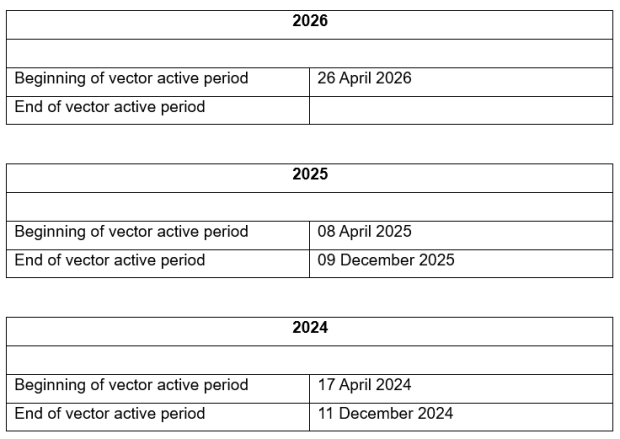
Beginning and End of Vector Active Period
The Agrifood and Biosciences Institute (AFBI) conducts entomological surveillance to help determine the beginning and the end of the vector active period in Northern Ireland.
The tables below record the beginning and end dates of the vector active period for the last three consecutive years.