‘Get An Air Pollution Assessment’ – A New Air Pollution Assessment Service
The Department of Agriculture, Environment and Rural Affairs carries out a range of work to monitor and improve air quality in Northern Ireland. Alongside DEFRA, DAERA has provided funding (including Carrier Bag Levy funding) for a unique project to develop an online tool for assessing the potential impact of air pollution on sensitive, designated sites.
A new air quality assessment tool, called the ‘Get an air pollution assessment’ service (called UK Air Pollution Assessment Service (UK APAS) during development) is now available (from 12th May 2026) for Northern Ireland users; Get an air pollution assessment - GOV.UK
The tool helps applicants to assess the impacts of their proposed development on the natural environment, specifically designated sites including Special Areas of Conservation (SACs), Special Protection Areas (SPAs), Areas of Special Scientific Interest (ASSI) and other sensitive habitats.
About the ‘Get an air pollution assessment’ service
Alongside DEFRA, SEPA and Scottish Government, DAERA has provided funding through the Carrier Bag Levy for a unique project to develop an online tool for assessing the potential impact of air pollution (ammonia, nitrogen oxides and nitrogen deposition) on sensitive, designated sites.
The ‘Get an air pollution assessment’ service is a tool to risk assess air pollution effects on ecosystems in the UK. This service will help streamline assessments that underpin decision making by local planning authorities and those issuing environmental permits. The tool has been developed by the UK Country Nature Conservation Bodies and regulators.
Although the tool focuses on the designated site network, including Special Areas of Conservation (SACs), Special Protection Areas (SPAs) and Areas of Special Scientific Interest (ASSI), applicants can access the impacts of their proposal on Priority Habitats outside the designated site network, including Sites of Local Nature Conservation Importance (SLNCIs), using assessment points.
A ‘Quick Run’ option is available to help with scenario testing, however, the formal assessment option within ‘Calculation Jobs’ should be used for submission of a planning or permit application.
Once an applicant is content with their application, they should export the PDF report, which can be submitted with their planning or permit application.
Please note, the information within the tool is based on the best available scientific information. The tool will be updated when new information becomes available and it is feasible to do so.
Applicants, with the aid of consultants/agents, can access the tool free of charge at the point of use. There is an integrated user guide and help desk available Monday to Friday 08:00 – 16:00 using the following contact details: 0330 124 2162 (call charges may apply) or get.an.air.pollution.assessment@defra.gov.uk.
Please provide any feedback on the tool using the ‘feedback’ link within the tool.
Background
Air pollution, in the form of nitrogen oxides and ammonia emissions, acts as a widespread pressure on semi-natural habitats in Northern Ireland and across the UK. These pollutants are released into the atmosphere from agricultural activities (ammonia), and traffic and industry (nitrogen oxides).
Exposure to these pollutants can have harmful impacts on biodiversity. They can be directly toxic to sensitive plants, or cause excessive nutrient enrichment, resulting in changes in species composition. Excess nitrogen deposition can also affect the ability of habitats to resist disease and adapt to environmental stresses, such as climate change. In Northern Ireland, the ambient ammonia concentrations and nitrogen deposition rates are above the levels that are known to cause harm to biodiversity.
Controlling the amount of excess ammonia and nitrogen reaching habitats relies on risk assessments. These assessments are used to inform planning and permitting decisions about new emission sources. In the UK, there is a range of mechanisms currently used for modelling air pollution and assessing risks to habitats from new development proposals. Relevant information on habitat sensitivities, emission factors and mitigation measures, for example, is held by many different sources and can be difficult to find.
The Integrating Tools for Air Pollution Assessment (ITAPA) project assessed the different approaches in use, and made recommendations for streamlining ecological risk assessment of air pollution in the UK. The project concluded that an integrated tool would provide the best cost-benefit for risk assessment of air pollution effects on ecosystems. An integrated tool should combine screening and detailed air dispersion modelling, incorporate up-to-date emission factors, mitigation measures and habitat data, enabling users to design, test and assess the potential impact of development proposals on the natural environment.
This integrated tool includes both Calculator and Archive modules. The Calculator provides detailed modelling that calculates the amount of nitrogen emitted from a proposed development, its dispersion in the air and deposition on protected sites. The Archive facilitates in-combination assessments, taking account of multiple projects that have emission footprints that could act in-combination to potentially increase the effect on sensitive habitats.
If you wish to find out more information, please email the NIEA Natural Environment Division’s Air Quality and Biodiversity Unit at AQBU@daera-ni.gov.uk.
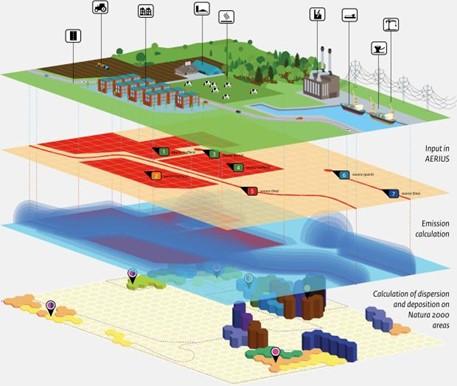
Schematic of the AERIUS Calculator, which the ‘Get an air pollution assessment’ service calculator is based on. The AERIUS Calculator combines emissions across sectors, performs dispersion modelling, and calculates the concentration and deposition on ecosystems to support the Dutch Integrated Approach to Nitrogen (PAS). Source: Dutch Ministry of Economic Affairs.
Key Benefits
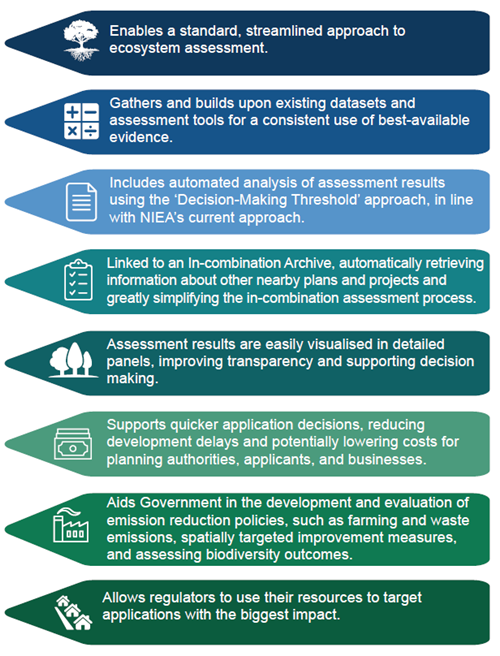
Source: Joint Nature Conservation Committee (JNCC)
Further information; UK Air Pollution Assessment Service | Advisor to Government on Nature Conservation | JNCC