Domestic consent to discharge - guidance
Under the Water (Northern Ireland) Order 1999, you must obtain a Consent to Discharge from the Department of Agriculture, Environment and Rural Affairs (DAERA) before discharging trade or sewage effluent to a waterway or to groundwater. This applies to wastewater from commercial, industrial and domestic properties that are not connected to the public sewer network.
The Domestic Discharge Application process is intended for single rural dwellings where the environmental risk from the discharge is considered low. This streamlined process allows for the efficient assessment of applications relating to an individual property.
IMPORTANT: A Domestic Consent can only be issued for one dwelling. If two or more properties are served by the same septic tank or wastewater treatment system, the discharge will not qualify for a Domestic Consent.
Where multiple dwellings are involved, you must first seek advice from NI Water regarding the availability of a connection to the public sewer network. If a sewer connection is not possible due to capacity constraints, you will need to apply to NI Water for a Wastewater Impact Assessment. In these circumstances, an application for a Trade Consent will be required instead.
If your application relates to multiple dwellings or forms part of a housing development, additional information may be required before it can be processed. You will need to provide evidence that the possibility of connecting to the public sewer network has been considered, such as a Pre-Development Enquiry (PDE) response from NI Water.
For further information on developer services and sewer connection enquiries, visit the NI Water website.
About the application
The full application is online, if you have difficulties completing the online application or uploading documents, for example:
- you do not have internet access
- you do not have access to a device like a laptop or smartphone
- you do not have a family member/friend to assist you in the application process
please contact consentapplications@daera-ni.gov.uk or telephone 028 9262 3150.
Sign in
To protect applicant privacy and secure your data, DAERA need to know it’s you (not someone pretending to be you), in order to ensure your information is safe. You must therefore log in before any online application can be made or information can be accessed on your DAERA online services. Once you have applied for access, it is your responsibility to keep your DAERA Online Services account details safe and secure.
To use the domestic consent to discharge online application portal, you will be offered the option to log in using one of 2 methods -
NI Direct (NIDA) account
- Used only for Northern Ireland government services
- Simple registration (email + password)
- Your account is not shared with HMRC or UK-wide tax systems
- Managed by Northern Ireland departments, not HMRC
Government Gateway account – 12 digit number and password
- Used across the whole UK
- Strong identity verification (requires Passport or driving licence, verified by one of 12 DAERA Direct Regional offices across NI)
- Two-factor authentication is required
- Can be for individuals, sole traders, agents
You can log in to either using an existing account details or register for a new account.
Please ensure you are signed in with the correct account as the email address entered is correct before proceeding, as all Water Management Authorisation System (WAMS) requests, notifications, and status updates will be sent to this address.
To get help with log in please see the links below:
- NI Direct - nidirect account support | nidirect
- Government Gateway - daera.helpline@daera-ni.gov.uk
- By telephone on 0300 200 7840
Online application dashboard – My domestic consents
This will show all applications you have applied for online for the account used to sign in.
You may search by reference number, applicant name, site address or application date.
The status of each application will be reflected on the column on the right and you will also be able to see here the consent number for each application when the consent issues.
You can access each application by selecting the record and from here you will be able to view/print the application, carry out any actions you are required to make, such as make payment or provide any additional information that may be requested.
Once the process is complete, you will be able to download your consent documents here.
Each application that has been submitted will show the status it has reached. You will be able to search using these statuses
- Unsubmitted - application started but not yet submitted
- Under Initial Review - application with the Department, undergoing initial application checks
- Information Requested - we need something further to progress the application to the next stage
- Payment Due/Overdue - initial checks complete, please now pay application fee
- Under Consideration - application with scientific staff for assessment
- Pre-Refusal Issued - application has had 28 day pre-refusal notice issued
- Consent Issued - the final consent has issued and is available to view for a limited time
- Application Withdrawn - the application withdrawn by applicant
- Application Refused - application has been refused by the Department
- Consent Revoked - the consent is no longer valid
Once a consent has issued it will remain on the registrant’s dashboard for 28 days. All valid consents can then be found on the Domestic Consent Public Register.
Application types
- New: you are applying for a single domestic dwelling that is being/ just been built or for an existing house that is not connected to the main NIW sewer system but has never previously had a consent to discharge issued
- Variation: you want to amend or change the details of an existing consent to discharge e.g. relocating the system or discharge point or replacing a septic tank for a new treatment plant
As part of the application, you will be required to provide the existing Consent to Discharge reference number for the property and give full details of the changes you are proposing.
You will be asked to give more details of the changes requested. Please provide as much information as possible about the proposed changes. For example, explain whether the discharge point is being moved, the treatment system is being upgraded, or the volume of effluent is increasing. Providing clear and detailed information will help us assess your application more efficiently and reduce the likelihood of delays.
Note: To update an existing consent for a system that was consented but not built, choose ‘Variation’ as the application type and ‘Proposed’ as the discharge status. The application form will then display the questions relevant to this scenario.
- Transfer of Ownership: you want to change the name on an existing consent because the property has been sold or a new person wants to take responsibly for the discharge. You will need the existing Consent to Discharge reference number and details for both parties involved i.e. the existing and proposed consent holders.
Note: You may be required to provide and upload evidence for the other party involved in the transfer (i.e. authorisation from the new consent holder or current consent holder that is surrendering the consent).
Domestic Consents Public Register
The Domestic Consents Public Register (DCPR) is now available online, allowing you to search for domestic consent details.
Before making an application
- You must check the DAERA Public Register before applying for a new consent for an existing system, to confirm that a valid consent does not already exist.
For Variation and Transfer of Ownership applications, you must confirm that the consent number you wish to use:
- exists on the register, and
- is in an acceptable format before submitting your online application.
Please ensure the consent number is entered exactly as it appears on the register.
Most domestic consents, including maps for consents granted from 1992 to the present, are available to view and download. If a consent for a premises is not available online, you can request a copy by following the instructions provided on the website.
How to search
The easiest way to search the register is to enter the road name in the Site Address field (for example, “Church r”) and review the list of results.
If no consent is found, try searching using the townland name instead.
To avoid missing results, we recommend not completing all three search fields unless you are certain the details exactly match the information held on the register. Entering too much information can overcomplicate the search and may return no results.
Public Register information
Your application, the information it contains, and any associated maps, site plans, or supporting documents will be placed on the Domestic Consent Public Register in accordance with Article 30 of the Water (Northern Ireland) Order 1999.
In this section, you must select one of the following options.
If you request exclusion from the public register, you must clearly state the reason for the request and specify the relevant Article under which the request is made.
- Confirm your agreement to the publication of your application and associated documents on the public register; or
- request that some or all of this information be withheld from the public register under:
- Article 31 (National Security), or
- Article 32 (Commercially Confidential Information) of the Water (Northern Ireland) Order 1999
Application contact details
The Registrant is the person who is signed in to the portal and completing the online application form. This may be the applicant, or someone acting on their behalf, such as an agent, solicitor, architect, friend, or family member who has been authorised to submit the application.
The Applicant is the person (or persons) who will be named on the final consent document as the consent holder(s). The applicant(s)/consent holder(s) will be legally responsible for the discharge and for ensuring compliance with all conditions attached to the consent.
If responsibility for the discharge is shared, you may add multiple consent holders to the application.
For each consent holder, you must provide:
- Full name
- Valid UK address, including postcode
- Telephone number
- Email address
Please ensure all contact details are entered accurately and in a valid format.
Important:
- Check Applicant Details Carefully. Once you submit your application, you WILL NOT be able to change the applicant details.
Before continuing, make sure all names, addresses and other applicant information are correct. If any applicant details are entered incorrectly, you may need to submit a new application and depending on stage or processing, pay the application fee again. Please take a few moments to check all details carefully before submitting. - A valid postal address within the United Kingdom must be provided for each Consent Holder. This address will be used for the service of notices and other official correspondence relating to the consent. Failure to provide a valid UK address may result in the application being deemed incomplete and may delay or prevent its processing.
- Transfer of Ownership Applications The current consent holder is the person giving up ownership of the consent. The new consent holder is the person who will become responsible for the consent once the transfer is approved.
If you are applying to transfer an existing Consent to Discharge, you must tell us which of the following applies to you:- I am the current consent holder (or applying on their behalf) and I want to transfer the consent to a new owner.
- I am the proposed new consent holder (or applying on their behalf) and I want the consent to be transferred into my name.
Application payment options
Once your application has been reviewed by a member of the Consents Team, you will receive an email inviting you to log back into the online Water Authorisation Application portal to make payment.
The applicable fee will be calculated according to the discharge application type selected and will be displayed on the payment screen.
You can choose to pay online via WorldPay or by BACS transfer:
- Online (WorldPay) – This option takes payment immediately using a debit or credit card and is the fastest and most convenient method. Simply enter your card details into our secure portal to make payment directly to the Department of Agriculture, Environment and Rural Affairs (DAERA) bank account.
Your application will progress to the next stage on the same day, and you will receive instant proof of payment. - BACS – This option involves a bank-to-bank transfer and typically takes 3–5 working days to clear. You will need to set up the Department of Agriculture, Environment and Rural Affairs (DAERA) bank account as a payee before making payment. Once the transfer is made, the payment must be confirmed manually, which may delay the processing of your application compared to an online payment.
Make a note of the fee displayed on the payment screen when you choose this option, as you will need to send us that amount.
- Account name: DAERA General Account
- Bank Details: Danske Bank
- Sort code: 95-01-21
- Account no: 61253506
- IBAN: GB67 DABA 9501 2161 2535 06
- BIC/SWIFT: DABAGB2B
View summary of Consent to Discharge Applications Fees and Charges
For alternative payment methods please contact consentapplications@daera-ni.gov.uk or telephone 028 9262 3150
Site location map and site plan
Site address
Please enter the full address and postcode of the discharge site.
When no full postal address for the site is available please use the address on the Planning Permission form.
For addresses that have not yet been allocated a full postal address by Royal Main you can add details such as ‘between’ or ‘adjacent to’ in either of the house number or building name fields
Directions to site
Use this section to provide clear directions to the site, along with any specific information needed to locate the septic tank or treatment plant within the site boundary.
Where possible, please consider including a What3Words location to help pinpoint the exact area.
What3Words divides the world into 3m² squares, each identified by a unique combination of three words. It is widely used by emergency services, delivery companies, and outdoor professionals to share precise locations quickly and accurately.
Alternatively, you may provide clear directions to the discharge point or relevant infrastructure (for example: proceed along the lane to the right of the garage for approximately 50 metres; the tank access is located beside the maple tree on the left).
Note: information submitted as part of the application may be published on the DAERA Public Register. Applicants should therefore avoid including any sensitive or personal details that they do not wish to be made publicly available.
Council area
Please select from the drop down list the relevant council area for the site address being applied for.
Site location map and site plan uploads
Note: It is important to ensure that the point(s) marked on the map must correspond with those shown on the uploaded documents. If there is a discrepancy your application may be returned for clarification
As well as plotting your discharge point (and sampling point if available) on the online geo-spatial map you will be required to upload a site location map and site plan as part of your application.
Note: For discharge to underground stratum, the discharge point is taken as the starting point of the sub-surface irrigation. For discharge to a waterway or waterway via underground stratum, the discharge point is taken as the point where the discharge enters the waterway.
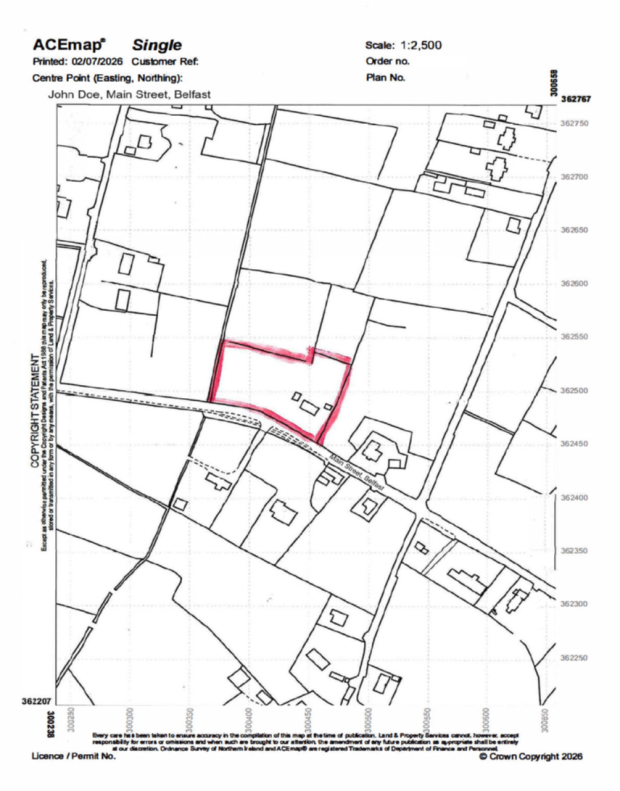
A site location map (scale no larger than 1:2,500) outlining the site for the premises to be consented in red and showing it in relation to the surrounding area, including named roads in the vicinity. Only the site of the premises to be consented should be outlined. Nearby waterways should also be identified.
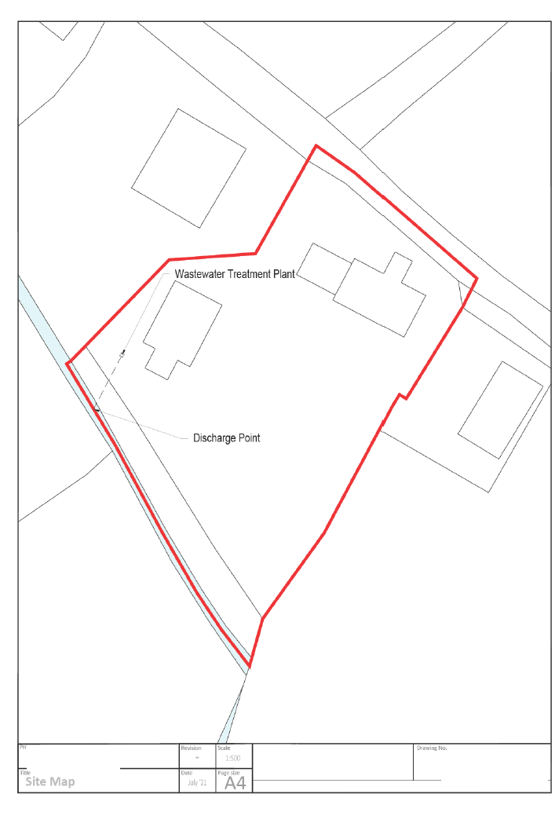
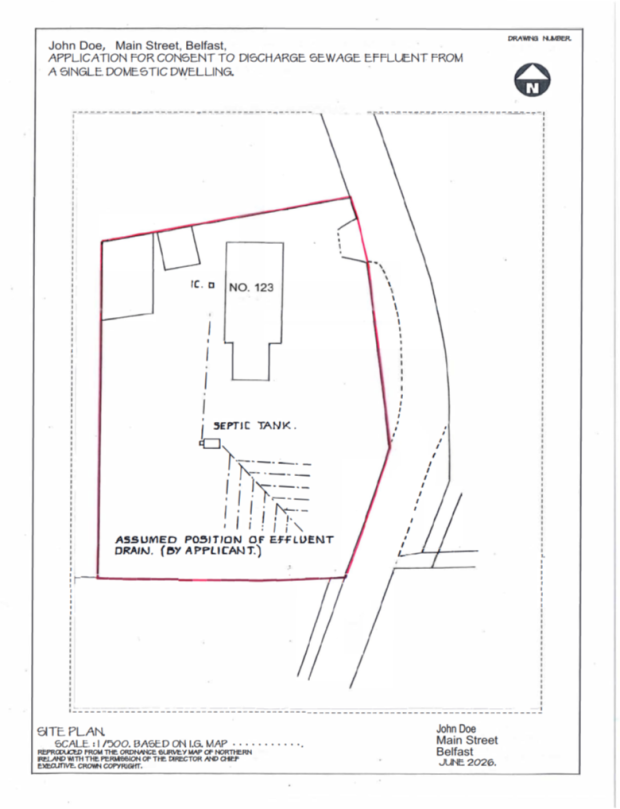
A site plan (scale no larger than 1:500) clearly showing -
- The location of the sewage treatment plant or septic tank, the location, extent and layout of the sub-surface irrigation system (SSIS)
- OR
- the location of the STW and the route to the waterway to which the discharge is to be made,
- The location of the effluent discharge point,
- The location of the effluent sampling point.
Please mark if there is a foul sewer available into which the discharge could be made. If unsure, please contact NI Water on 0345 7440 088 to check.
See Addendums at end for further details.
- Addendum 1 - Guidance on obtaining maps from Ordnance Survey
- Addendum 2 - Example Location Map
- Addendum 3 - Example Site plan – discharge to Sub-surface Irrigation System
- Addendum 4 - Example Site plan – discharge to a Waterway
Uploading documents onto Consent to Discharge online application portal
When you are asked to upload a document such as site location map, site plan or CE certificate please follow these steps
- Choose File - this opens a new window
- Find the location of the document you wish to upload from the list on right hand side of the screen showing places your device stores documents
- Highlight the document to be uploaded in the main section of the screen
- Click ‘Open’. This screen will disappear and you are returned to the application form
- Alternatively, you can click the ‘Upload from mobile’ button to add a document if using a smart phone/tablet
- The document should appear on the screen (allow a short time for this to fully upload). You can repeat the process to add another document or hit continue to complete this action and move to the next section of the application.
Some uploads, such as location map and site plan, are compulsory to complete that section of the application i.e. you will not be permitted to submit an application without them.
You will be given an opportunity at the end of the application to upload any additional information you wish to give us in support of your application.
- Choose from the drop down box or pick other if the document type is not specified in the list.
- Please ensure your document is clearly named before uploading
Geo-spatial information capture
You are required to plot the discharge point being applied for.
If you already know the easting and northing of your discharge point (and sampling point if available) you can key the co-ordinates to the fields on the right hand side of the page, select a point type and name it.
Click ‘Add point’ which will add a marker on the map and be shown at the bottom of the page under ‘All Points’
Alternatively, you can zoom in on the map provided, click settings and choose Discharge or Sampling and mark the point on the map manually.
This will then be added to ‘All points’ at the bottom of the page and give you the easting and northing co-ordinates.
Protected sites
You can use the protected site layer list on the application to show where the proposed/existing discharge point is in proximity to an ASSI, SAC, SPA and Ramsar. Click on the arrow to the right of 'Layer List' to open a drop-down box which will allow you to add this layers to the map.
For additional assessment on hydrological linkage (drains into) to a protected site, applicants can avail of the NIEA Natural Environment Viewer. This will allow assessment on identifying if the proposed discharge is hydrologically connected to a protected site and the distance to it. If a discharge is hydrologically connected your application may require further assessment, and this should be recognised at the application stage.
Planning permission and sewer infrastructure
Please complete all three questions on this page. Selecting 'Yes' will open a text box where you can provide additional details. If you answer 'No' to any question and the information is later found to be inaccurate, this may delay the processing of your final consent while further clarification is sought.
In this section, you must confirm whether planning permission has been applied for or granted. This is most relevant where the application relates to a proposed consent and the property has not yet been built or has only recently been constructed.
You must also confirm whether the application relates to multiple dwellings or forms part of a housing development. If so, we may need further information before we can continue processing your application. You can provide these details here and may upload any relevant supporting documents at the end of the application.
Finally, please advise whether there are any sewers that form part of NI Water’s network within 20 metres of the site boundary or the owner’s land. Where the discharge applied for is proposed, you may refer to the Pre‑development Inquiry submitted as part of the site’s planning application. You will have the opportunity to upload this document in the 'Other Documents' section at the end of the application.
Information on the discharge
These screens will determine the type of discharge being applied for.
1. Discharge details
Specify whether the discharge from the septic tank or treatment plant flows to a waterway or to a sub-surface irrigation system/underground stratum (previously known as a soakaway) by selecting the appropriate option.
Note:
- Where the final effluent ultimately discharges to a waterway, even if it passes through an additional form of sub-surface filtration/soakaway prior to discharging to a waterway, the option ‘Waterway’ should be selected. Additional information can be provided in later questions, and additional uploads can be provided at the end of the application.
- Alternative Method selection – Where an alternative method is proposed – select sub-surface irrigation system/underground stratum and complete the percolation tests to the values to which the system is proposed to achieve, this will be confirmed by the consenting officer. Additional information can be provided in later questions, and additional uploads can be provided at the end of the application.
2. Discharge status
You must indicate whether the discharge relates to:
- a proposed discharge – associated with a new or recently constructed dwelling; or
- an existing discharge – where the system is already installed and operational.
Note: If a proposed discharge is selected you will need to know an approximate date that the discharge will start to give us this on the application form.
The questions you are asked from this point in the online application will only be relevant to the application type selected:
- Sub-surface irrigation system – Existing system
- Sub-surface irrigation system – Proposed system
- Waterway - Existing system
- Waterway – Proposed system
Note:
- NIEA's hierarchy of discharge solutions is discharging to NI Water's infrastructure, where possible. In cases where this is not possible, the next option to be considered should be discharge to sub surface irrigation, with discharge to waterway being the third option (least preferable).
- A discharge from an existing septic tank to a waterway cannot be approved without secondary treatment, such as a gravel filter bed.
Sub-surface irrigation system – Existing system
Note: If a sub‑surface irrigation system is installed it must be capable of dispersing all the effluent discharged. There should be no ‘ponding’ of effluent on the ground surface immediately above or around the sub‑surface irrigation system at any time. The discharge must never migrate from the sub‑surface irrigation system to a waterway.
- You should choose the type of system that is currently installed.
- You will need to give us further details of the system in place and indicate by ticking yes or no whether any additional treatment such as sand/gravel filters or a constructed reed bed is being used.
- Insufficient detail in this section may result in the application being returned so please tell us as much information as possible in this section.
Sub-surface irrigation system – Proposed system
Note: You MUST upload a copy of the CE Certificate for the proposed system with your application before the processing of your application can begin.
- You should choose the type of system that you are proposing to install.
This field is asking for the Biochemical Oxygen Demand (BOD) removal efficiency of the wastewater treatment system you are installing.
If you are installing a package sewage treatment plant, enter the percentage (%) BOD removal stated on the manufacturer's certificate or performance documentation (for example, 95%, 97.5%, etc.). This information is usually found on the system's test certificate, declaration of performance, or technical specification supplied by the tank provider. If you are installing a septic tank, you do not need to provide this information and can leave the field blank.
- You will need to give us further details of the system in place and tell us by ticking yes or no whether any additional treatment such as sand/gravel filters or a constructed reed bed is being used.
- Insufficient detail in this section may result in the application being returned so please tell us as much information as possible in this section.
- The next four questions relate to the proposed system and its position within the site and surrounding environment. A 'Yes' or 'No' response is required for each question to complete this section of the application.
Percolation tests
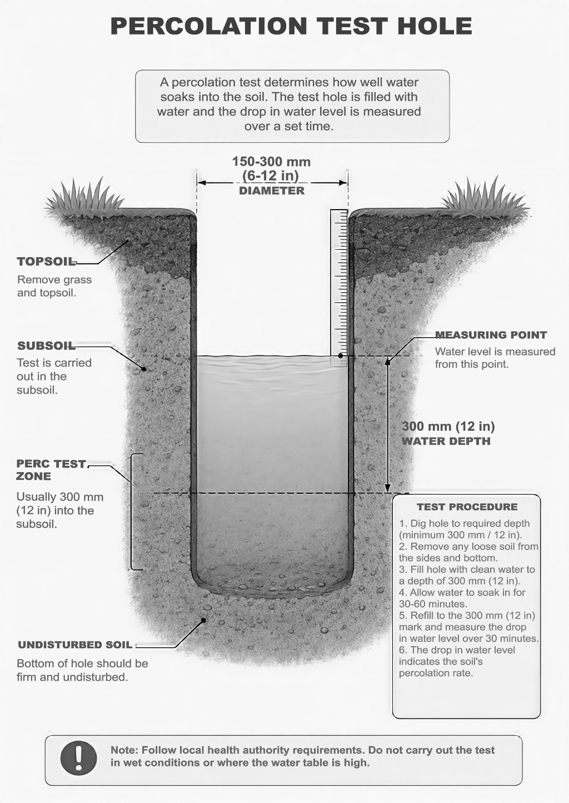
Percolation tests must be carried out in accordance with British Standard BS6297 for any consent to discharge into a sub-surface irrigation system.
Percolation tests determine the area of the subsurface irrigation system and length of percolation trenches required to disperse the effluent. Soil porosity can vary across a site therefore the percolation test should be carried out at the intended location of the proposed system.
Avoid carrying out this test in extreme weather conditions such as drought, frost and heavy rain. The test hole should be left in test condition and covered over so that it may be inspected if required. Failure to do so may result in your application being rejected.
- If an alternative sub-surface irrigation system is proposed please provide further details in the main application form.
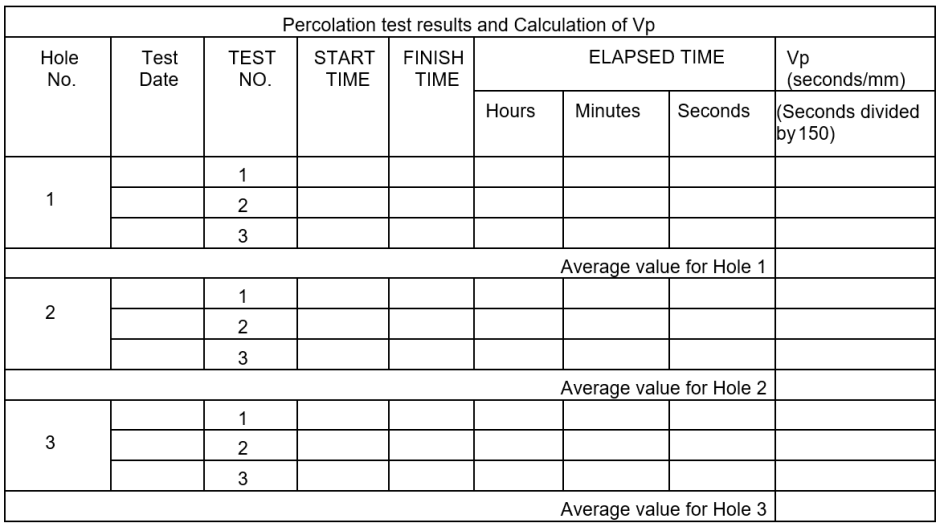
- Before you can submit your application you will be required to provide details of the test results for a minimum of 2 holes with a minimum of 3 tests for each hole recorded.
- Tell us the percolation value (Vp) for all the test holes, the application system will work out the average VP.
- Manually input the area in square meters of the sub-surface irrigation system and minimum length of the irrigation drains for the system being applied for.
- You need to upload evidence of the test holes & proposed sub-surface irrigation system (with timestamps).
Note: NIEA will consider the use of a sub-surface irrigation system when the Vp value is between 15 and 100. For Vp values between 1 and 15 or greater than 100, consult with the regulator to identify options for disposal. Any proposed discharge to underground strata would be required to comply with BS6297 guidance.
How to carry out a percolation test
- Excavate at least two holes 300mm² to a depth of at least 300mm below the proposed invert level (bottom of pipe) of the infiltration pipe and space them evenly along the proposed line of the sub-surface irrigation system.
- Saturate the local soil by filling each hole with water to a depth of at least 300mm and allow this to seep away completely.
- If the water drains rapidly (within 10 minutes) the hole should be refilled up to a maximum of 10 times. If the water continues to drain away rapidly the ground is unsuitable.
- If the water has not soaked away within six hours the area is not suitable.
- Determine the percolation rate by refilling each hole with water to a depth of at least 300mm and observe the time in seconds for the water to seep away from 75% full to 25% full (i.e. a depth of 150mm).
- Divide this time by 150, this answer gives the time in seconds required for the water to drop 1mm.
- The test should be carried out at least three times in each of at least two percolation holes in the location of the proposed trenches.
- The percolation value (Vp) is obtained by summing all the values, from a minimum of three tests in at least two holes, and dividing by the number of values used (a minimum of 6).
Percolation Test recording table
You may find this useful to complete manually before entering the details into tyour online application. (System will work out your overall average VP.)
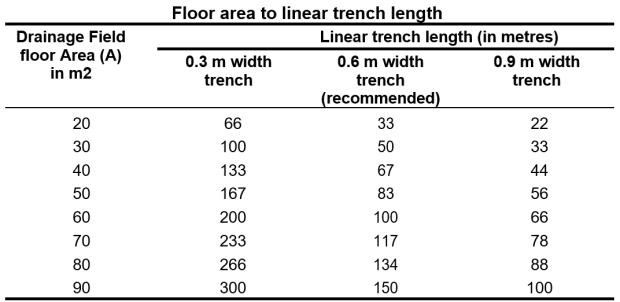
Calculating trench area and trench length
The layout of the trench network will depend upon the soil porosity and the availability of land. The floor area of the drainage field required may be calculated as follows:
A = p x Vp x 0.25 for septic tanks
For effluents which have received secondary treatment the area can be reduced by 20%
A = p x Vp x 0.20 for package treatment plants
Where;
- A is the required drainage field floor area in M².
- p is the number of people served by the tank. This should be the maximum number of people that may live in the dwelling.
- Vp is the percolation value.
The drainage field floor area should then be converted to an amount of linear trench based on the width of the trench see the table below drainage trenches width should be between 0.3 to 0.9 meters.
Waterway – Existing system
Note: If you are applying for consent to discharge for a septic tank this cannot be approved without secondary form of treatment such as a gravel filter bed.
- You should choose the type of system that is currently installed.
- You will need to give us further details of the system in place and tell us whether any additional treatment such as sand/gravel filters or a constructed reed bed is being used.
- Insufficient detail in this section may result in the application being returned so please tell us as much information as possible in this section.
Waterway – Proposed system
- NIEA's hierarchy of discharge solutions is discharging to NI Water's infrastructure, where possible. In cases where this is not possible, the next option to be considered should be discharge to sub surface irrigation, with discharge to waterway being the third option (least preferable).
- You should choose the type of system that you are proposing to install.
- Upload of a CE Certificate for the proposed system is compulsory to complete this part of the application. See section - UPLOADING DOCUMENTS ONTO CONSENT TO DISCHARGE ONLINE APPLICATION PORTAL for more detail on how to do this.
- A CE marking is a compliance system based on European standards. It shows the manufacturer has tested the tank to the relevant standard, produced a Declaration of Performance and confirmed compliance with EU/UK construction product rules. All new treatment plants sold should have one of these.
- You should complete the % BOD removal for the system being installed. You will find this information on the certificate given to you by your tank provider.
- You will need to give us further details of the system in place and tell us whether any additional treatment such as sand/gravel filters or a constructed reed bed is being used.
- Insufficient detail in this section may result in the application being returned so please tell us as much information as possible in this section.
Supporting documentation
In this section, you will find a list of all documents you have already uploaded throughout your application. You can also submit any additional required documents here by selecting the appropriate document type from the dropdown menu.
You may upload any other supporting information you would like us to consider when reviewing your application. Please ensure all documents are clearly labelled with a description of their content.
- Alternative Sub-surface irrigation system (see examples below)
- Photographic evidence of the waterway
- Single unit pre-development enquiry
- Single unit wastewater impact assessment
- Other (GIVE DETAILS)
Examples of alternative Sub-surface irrigation systems
Raised Mound Systems
- A constructed sand mound with embedded distribution pipes.
- Used where natural soil conditions are unsuitable, such as: High groundwater tables, shallow bedrock, poorly permeable soils
- Effluent is pumped into the mound for treatment and dispersal.
Declaration
Once the application is complete and the registrant is content with the information provided they must agree to all points on the application declaration to proceed by clicking the box.
Application submission
You may review your application here and, once you are satisfied that all information provided is accurate and complete, submit the final application. Submission will forward your application to the Northern Ireland Environment Agency (NIEA) for an initial review to carry out preliminary checks.
This is your only opportunity to download a PDF copy of your completed application. You should ensure that you save or retain this copy for your records, as it will not be available to download at a later stage.
What happens next
Following the initial review by the Agency’s administrative team, you will either:
- receive an email requesting that you log into the Water Authorisation Management System (WAMS) portal to make the required payment (see section entitled ‘Application Payment Options’ above); or
- be contacted to provide additional information where necessary before formal processing of your application can begin.
Addendum 1
Guidance for applicants requiring maps for Domestic Consent applications
The OSNI Address Centred Extract (ACE) is a large scale location map for Northern Ireland used for things like planning and property conveyancing. ACEmap is the most popular product in the OSNI product range. You can order it electronically and it will be delivered by email.
How is ACEmap generated?
The map is generated directly from OSNI Largescale vector data and is surveyed at 1:1,250 or 1:2,500 scales.
The ACEmap is centred on a site specific area, either in landscape or portrait orientation, at scales of:
- 1:500
- 1:1,250
- 1: 2,500 or
- 1: 5,000
It is available in PDF format and can be downloaded in either A4 or A3 size. You can also order it in paper format in sizes A4 – A0. Both the paper and PDF versions of ACEmap have Irish Grid lines and coordinates shown directly on the map.
Each ACEmap is generated on a bespoke basis and uses the most up to date data available.
- Current prices
- Visit nidirect Map Shop
- Email Map Shop enquiries to Land Property Services: OSNIonline@dfpni.gov.uk
Addendum 2
Addendum 3
Addendum 4