The 4th Northern Ireland Countryside Survey
In 2022, DAERA awarded a 6-year contract to deliver the 4th NI Countryside Survey to the UK Centre for Ecology and Hydrology (UKCEH).

Field work for the 4th NI Countryside Survey is complete and analysis and report writing is ongoing
UKCEH are working in association with a number of sub-contractors, including Agri-food and Biosciences Institute (AFBI) and Queens University Belfast (QUB).

The 2022 contract forms part of the monitoring and evaluation framework of the Environmental Farming Scheme and was part funded by the European Agricultural Fund for Rural Development (EAFRD). It will also help inform a range of policy development and reporting obligations relating to the environment.
Press-release available from - https://www.daera-ni.gov.uk/news/new-countryside-survey-underway.
Survey Design
The methodology from the 3rd NI Countryside Survey was repeated with some key additions aimed at increasing the value of data collected in the field and integrating methodologies with other UK and NI surveys & monitoring programmes. New technology has been used to increase data accuracy and field work efficiency. The graphic below shows the range of changes between the 3rd and 4th NI Countryside survey.

Soil sampling and lab analysis - One of the most important additions to the 4th NI Countryside Survey, is the collection of soil samples, co-located with vegetation plots. These are being analysed by AFBI for a range of metrics indicative of soil condition and will for the 1st time in the history of the survey, enable integrated analysis of soil and habitat data. This will aid identification of linkages between soil health and habitat condition.
Revised plot sampling strategy - The sampling strategy for the plots recorded in the 3rd NI Countryside Survey was reviewed. Statistical analysis was carried out to ensure that it provided a properly representative picture of habitats, soils and vegetation across NI and a revised sampling strategy was developed. This new approach has:
- Ensured a more representative sampling approach across NI which included all squares and habitat types (including Improved Grassland Broad Habitat).
- Retained as many repeat plots as possible to ensure continuity between surveys.
- Included sampling of hedges and field edges which are important components of the NI agricultural landscape.
Hedgerow diversity - New Hedgerow diversity (D plots) were introduced to record woody species present in hedges, along with height and width measurements.
Peat depth measurements - A sampling strategy was designed to record depths of up to 3m in a range of peat habitats.
Veteran Tree recording - For the first time veteran trees were recorded, with up to a maximum of 10 trees recorded in each square.
Plot photographs - Plot photographs were introduced to provide additional information for data verification and easier navigation to the plot at re-survey.
Fully Georeferenced data - All point, line and polygon data recorded in the field, as well as plot photographs have been georeferenced. This means the data is anchored to a co-ordinate system, enabling accurate measurements and spatial analysis.
Fully digital recording - All field data was recorded digitally using electronic devices and uploaded live onto a cloud service.
Results and Key Findings
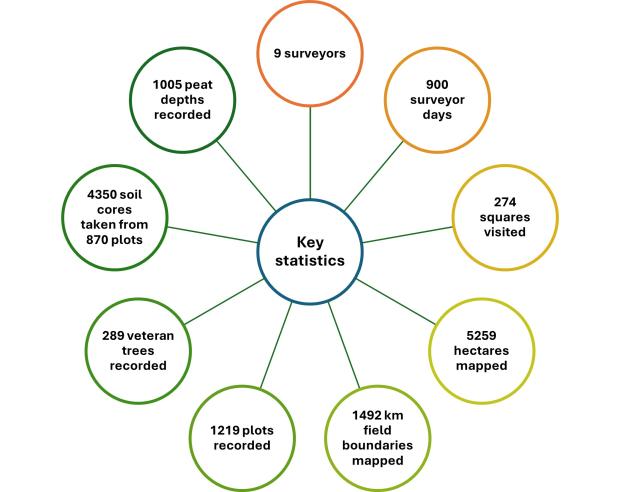
Field survey was carried out over 2 field survey seasons (2023 & 2024), with detailed results expected in 2026 upon completion of data analysis and report writing.
Key statistics from the past 2 survey seasons are shown on the graphic below.
Further information
Further information on the NI Countryside Survey methodology and history, as well as other reports can be found in the links below. Links to published survey reports for the 4th NI Countryside Survey will be provided when available.
Northern Ireland Countryside Survey
The 1st Northern Ireland Countryside Survey
The 2nd Northern Ireland Countryside Survey
The 3rd Northern Ireland Countryside Survey
Publications
NI Countryside Survey Publications
Any queries relating to NI Countryside Survey should be directed to EFS.MEF@daera-ni.gov.uk