Simple steps to prevent septic tank pollution
Septic tanks can play a role in causing water pollution. It’s important for householders to know where their septic tank is, and to ensure it’s working properly to prevent this from happening.
If you live in a rural part of Northern Ireland, you and your neighbours are likely to have a septic tank or a package treatment plant to manage wastewater and sewage from your property.
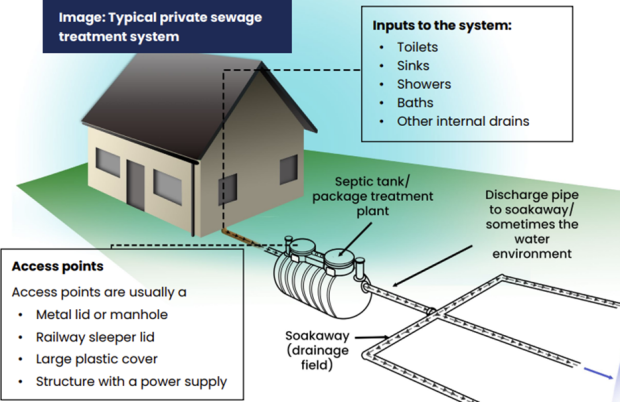
A septic tank works by holding on to sewage from your property for long enough to allow solids to form into ‘sludge’ at the base of the tank, where it is partly broken down by bacteria.
The remaining liquid drains from the tank by an outlet pipe and soakaway, so if your septic tank is not working properly, this can cause wastewater from your home to ‘leak’ into local waterways, causing pollution.
A package treatment plant more actively treats the effluent, prior to discharge. It requires a power source and regular maintenance. The discharge may be via soakaway or in some cases, if an appropriate level of treatment is in place, may be direct to a waterway.
All private sewage treatment is subject to approval from the Northern Ireland Environment Agency, and requires a consent to discharge. It’s illegal to discharge any effluent into a waterway or water contained in underground stratum without having a consent.
You can search The Domestic Consent Public Register Domestic Consent Public Register to check if your property has a consent.
All domestic consents and maps for consents granted from 1992 to present are available to download.
Applying for Domestic Consent
If your property does not have a Domestic Consent, you can apply online.
NIEA has an online application process for domestic consents at Regulating water discharges.
How to find your septic tank
If you aren’t sure if your home has a septic tank, look for access points – tanks are typically installed down slope from the building served, and must be at least seven metres from a residential building. Different vegetation patterns, typically nettles or greener or faster growing vegetation can indicate the tank and / or the soakaway location.
If you have a package treatment plant, you will see a manhole and should be able to hear a pump running.
Who has responsibility for your septic tank?
You as the householder are responsible for your private sewage treatment system (septic tank or package treatment plant) including the power source, if required, and any soakaway or discharge pipe. If a number of properties share the same tank, all owners share responsibility, even if the tank is not located on your property.
Septic tanks and treatment systems can wear down and leak over time, so it is important to ensure your system is registered and properly maintained to prevent it from causing pollution.
How to look after your septic tank
- Application: You need to apply for a consent to discharge for your septic tank or package treatment plant from the Northern Ireland Environment Agency. This can be done by applying online at Regulating water discharges
- Desludging: You should get your septic tank desludged regularly - how often this needs done will depend on your household size and usage. Northern Ireland Water provides a free desludging service (once per year) which can be arranged through its website at Arrange Septic Tank Emptying - Northern Ireland Water.
- Household cleaning products: The excessive use of detergents, bleach etc. kills off the bugs in a septic tank which are needed to break down waste effectively. Remember to use household cleaning products sparingly and choose septic-safe options.
- Maintenance: To keep your tank working effectively you should check it regularly and if you notice any issues such as leaks or blockages, strong smells or unclear discharge in the inspection chamber, that could indicate a problem and you should seek professional advice. Ensure clean rain water from roofs / yards is not allowed to enter the septic tank system.
- Watch this short video for advice on looking after your septic tank to help ensure it doesn't cause water pollution.
Private Sewage Treatment Systems Care and Maintenance: A Guide for Homeowners
Find out more about how to look after your Private Sewage Treatment System to keep it working properly and prevent it from causing water pollution.
Further information on how to maintain your septic tank is available at Maintaining your septic tank | NetRegs | Environmental guidance for your business in Northern Ireland & Scotland
If you have a package treatment plant it should be managed and maintained in accordance with the manufacturer’s or installer’s guidelines.