What is groundwater and why is it important?
Groundwater is an important, but often overlooked, part of our water cycle but it is a valuable resource that has many uses across our economy and society. The Northern Ireland Environment Agency is calling for people to become part of its Groundwater Monitoring Network to help better understand the health of Northern Ireland’s groundwater, as well as how it can be protected.
What is groundwater?
Put simply, groundwater is water naturally stored in the ground underneath the earth’s surface. The geological formations which contain groundwater are known as ‘aquifers’. All the aquifers in Northern Ireland have been divided into management units known as ‘groundwater bodies’.
There are 89 groundwater bodies in Northern Ireland – each with unique properties and their health (status) is assessed four times a year by monitoring for over 175 different indicators. It’s thought our ancestors knew about the existence of, and the value of groundwater as some researchers have suggested the locations of the historic Easter Island heads are to denote sources of groundwater!
Groundwater makes up around 98% of earth’s available fresh water. In Northern Ireland groundwater has lots of different and important purposes, from the manufacturing of soft drinks, to its role in the creation of the Marble Arch Caves and wetlands.
Understanding the value of groundwater
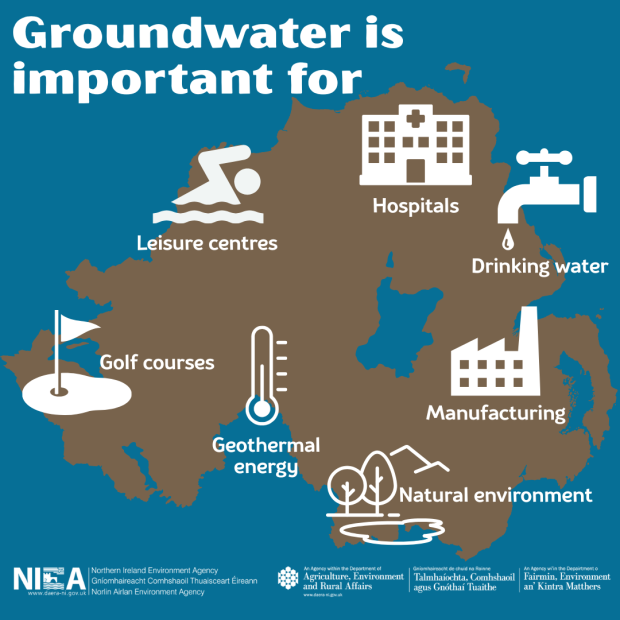
Groundwater supports our environment, economy and society, contributing to a more sustainable Northern Ireland in the following ways:
- Natural Environment: Groundwater makes our rivers and lakes more stable and creates important wetland habitats. It also helps create a special type of landscape in some areas of limestone, known as ‘karst’. Karst is an important part of our geological diversity.
- Public Water Supplies: Northern Ireland Water uses groundwater to provide part of its public water supply network, for example drinking water on Rathlin Island.
- Rural Private Water Supplies: Groundwater, from private boreholes, wells or springs, provides water to homeowners and farmers, particularly in remote areas where public supply is not available.
- Commercial Private Water Supplies: Groundwater, from private boreholes, wells or springs, provides water to various commercial and public buildings including hospitals, food/drink processors and dairies in the agri-food sector.
- Irrigation: Groundwater is used to supply water for irrigation. This includes for horticulture and recreational purposes, for example golf course irrigation.
- Geothermal Energy: Ground source heat pumps and heat exchangers can use the heat energy storage capacity of groundwater to heat and cool buildings. This is a natural and renewable energy source.
- Tourism: Groundwater has created and supports popular tourism sites including the Marble Arch Caves and Loughareema Vanishing Lake.
Right now, groundwater is not being used to its full potential and is considered by many to be a hidden asset for our economy. Work is underway to understand more about the power and potential of geothermal energy in Northern Ireland to better understand its untapped potential. Find out more about this project here.
Where can groundwater be found?
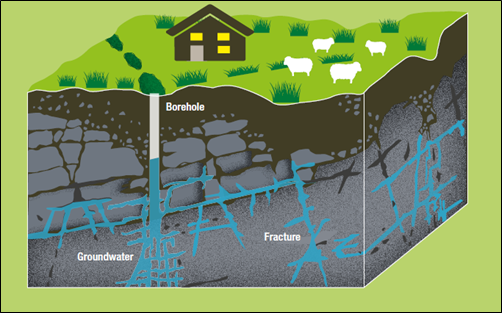
Groundwater is present almost everywhere underground and does not aways look like underground rivers or lakes.
Groundwater is water stored in the pore spaces and fractures (cracks) of geological formations (rock units) underlying our landscape. Sometimes the fractures become so big they form caves and conduits.
What are the risks to our groundwater?
Like the other ‘above ground’ water sources that we can see, groundwater quantity and quality needs to be protected to ensure it remains a sustainable resource. Groundwater quantity is regulated by the Northern Ireland Environment Agency through the abstraction licensing regime and the best way to protect groundwater quality is by managing potential sources of pollution.
Potential sources of groundwater pollution include:
- Leaks from machinery or oil tanks;
- Fertilisers / pesticides /sheep dips;
- Farmyard runoff;
- Misuse/disposal of chemicals;
- Poorly maintained septic tanks;
- Landfills;
- Unregulated waste activities;
- Cemeteries;
- Mining/quarries;
- Historical industrial sites;
- Livestock manure.
How is our groundwater monitored?
Teams from the Northern Ireland Environment Agency (NIEA) routinely sample and test groundwater quality and quantity, using a network of boreholes and springs. The data from this testing programme is used to help understand Northern Ireland’s natural groundwater conditions, as well as how groundwater can be impacted and protected.
You can view data for groundwater near you using NIEA’s Catchment Data Map Viewer and see protected sites which are sensitive to groundwater using the Natural Environment Map Viewer, both of which are available at DAERA Map Viewers | Department of Agriculture, Environment and Rural Affairs.
How you can support groundwater monitoring
While NIEA teams carry out monitoring and testing on those sites that they have access to, as there is no official ‘register’ of boreholes, they are always keen to identify further sites that may be used to enhance the testing regime.
If you have a borehole (or groundwater fed spring) on your property (whether domestic or commercial) and are interested in becoming part of the Groundwater Monitoring Network, get in touch with NIEA’s Land and Groundwater Team at groundwater@daera-ni.gov.uk. Members of the network can benefit from free water quality sample results.