Water Quality Matters: How the Northern Ireland Environment Agency is working to improve water quality and how your activities can make a positive difference
Within the Northern Ireland Environment Agency (NIEA) a number of specialist teams are working with colleagues from across DAERA and others to improve Northern Ireland’s water quality. Find out more about what they do and how we all have a role to play through our everyday actions.
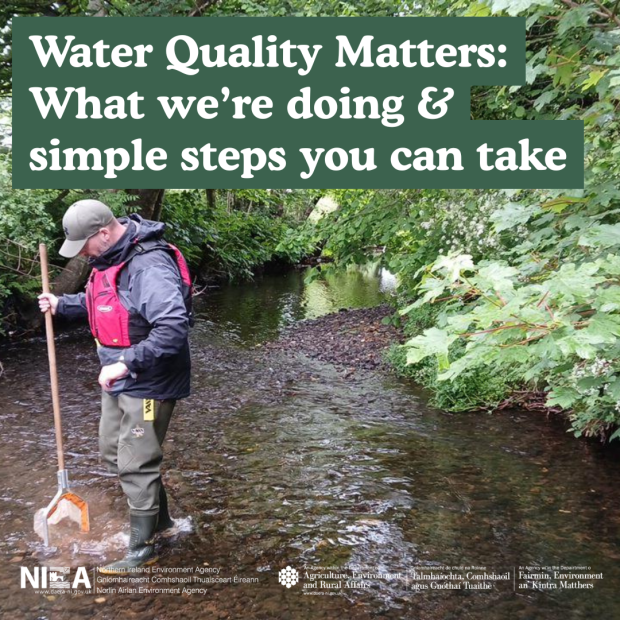
Role of the Northern Ireland Environment Agency (NIEA)
NIEA has a legal duty to promote conservation of water resources in Northern Ireland and the cleanliness of both surface water and groundwater. As part of its duties, NIEA must take into account the needs of industry and agriculture, as well as protection of fisheries and public health, the preservation of amenities and the conservation of flora and fauna.
Much of this work is the responsibility of the Agency’s Water Catchment Unit and Water Science and Evidence Unit, which comprise of multi-disciplinary teams of over 150 staff who work across the following areas:
Water Science and Evidence Unit
- Freshwater Monitoring and Assessment: Monitoring data collection and trend analysis of all elements of rivers and lakes.
- Water Chemistry Branch: Performing laboratory assessments of water quality samples for nutrients and chemicals.
- Freshwater Data Insights: Identifying and managing data streams across the Department to produce information to inform policy and identify areas of high priority for regulatory activities.
- Water Resources: Monitoring, assessment and protection of groundwater. Hydrological and morphology assessment and classification of freshwaters.
Water Catchment Unit
- Integrated Catchment Planning: Development of River Basin Management Plans through Significant Water Management Issues and draft River Basin Management Plan reports. Administering the Water Quality Improvement Strand of the Environment Fund. Publication of Water Classification Statistics for Northern Ireland.
- Pollution Prevention: Carrying out proactive inspections of industrial premises in relation to water quality.
- Pollution Response: Providing a 24/7 service to respond to reported pollution events to work out issues and resolve where possible.
- Water Quality Inspectors: Dealing with water quality issues across catchments on the ground on a daily basis, carrying out a mix of proactive and reactive work.
- Agricultural Regulation: Inspecting farming practices to check if they are in line with relevant policies.
- Catchments: Investigating priority water bodies and engaging with local stakeholders to support projects.
- Major Client Interface: Responding to planning applications and major infrastructure schemes.
Together they work to protect the water environment through a range of activities from monitoring water quality to taking actions to combat and minimise pollution.
Protecting our precious groundwater resource
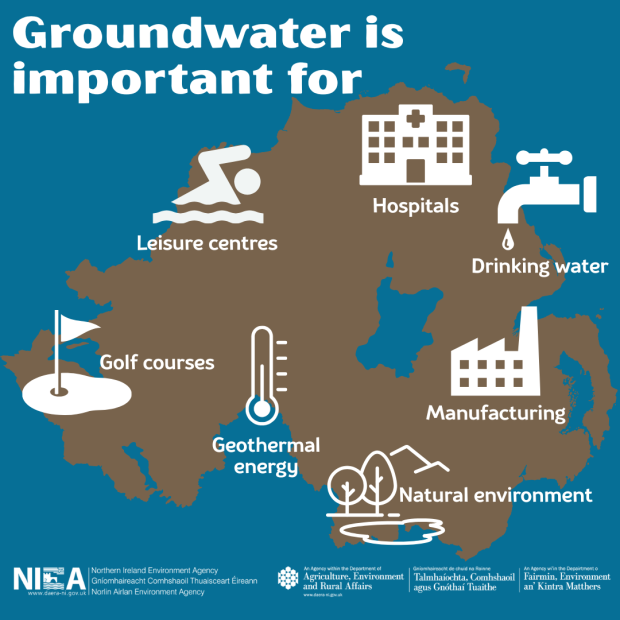
Groundwater is water naturally stored in the ground underneath the earth’s surface and makes up around 98% of earth’s available fresh water. In Northern Ireland groundwater has lots of different and important uses, from the manufacturing of soft drinks, to its role in the creation of the Marble Arch Caves and wetlands.
Protection of groundwater from over abstraction is an important function provided by NIEA, which is regulated through the abstraction licensing regime. Teams from NIEA routinely sample and test groundwater quality and quantity using a network of boreholes and springs. The data from this testing programme is used to help understand Northern Ireland’s natural groundwater conditions, as well as how groundwater can be impacted and protected.
You can view data for groundwater near you using NIEA’s Catchment Data Map Viewer. You can view groundwater monitoring locations using NIEA’s Water Information Request Viewer and see protected sites which are sensitive to groundwater using the Natural Environment Map Viewer, all of which are available at DAERA Map Viewers | Department of Agriculture, Environment and Rural Affairs.
What is water quality and how is it measured?
Water quality is the condition of water and includes chemical, physical and biological characteristics. A number of elements are measured and together they make up a water body’s ‘ecological status’ – this includes biological, physicochemical and hydromorphological elements (such as the shape of the river channel and the amount of water flowing through the river).
The goal is for all surface water bodies to have at least ‘good’ ecological status. In order for a surface water body to be classified as having ‘good’ ecological status, it must measure at ‘good’ for all elements. If one single element measures as ‘moderate’, the water body will be given an overall status of ‘moderate’ rather than ‘good’, even if all other elements are ‘good’.
The biological elements that are monitored, and which feed into the ecological status of our waters are:
- Invertebrates: animals lacking a backbone such as aquatic bugs, molluscs, crustaceans, spiders and insects.
- Macrophytes: aquatic plants large enough to be seen by eye.
- Fish.
- Diatoms: single cell algae.
Physicochemical elements are monitored on a monthly basis for a range of parameters which include, amongst others, Soluble Reactive Phosphorus (SRP), pH levels, dissolved oxygen, ammonia and suspended solids.
For the hydromorphological elements, the hydrology and morphology are assessed.
- Hydrology considers the flow and water levels in a waterbody
- Morphology considers the physical characteristics of the water body, in terms of erosion and deposition.
What is the ecological status of surface waterbodies in Northern Ireland?
The most recent assessment of Northern Ireland’s surface water bodies (rivers, lakes and marine out to one nautical mile) is published in the Water Classification Statistics for Northern Ireland 2024 report, which is available on the DAERA website here. The report shows that, in 2024, 29% of the 450 river water bodies were classified as good or high ecological status with 24% of the 21 lake water bodies classified as good ecological status and 40% of transitional and coastal waters achieving good ecological status. The target is for most water bodies to achieve 'good' or 'high' ecological status by 2027. Some lakes have extended deadlines to meet good or better ecological status, therefore they have lesser objectives of moderate, poor or bad by 2027.
How can I find out about water quality in my local environment?
Information on the ecological status of local water bodies from 2009 onwards is available through the NIEA catchment viewer, which is on the DAERA website NIEA Catchment Data Map Viewer | Department of Agriculture, Environment and Rural Affairs. There’s a short video explaining how to use the map viewer.
Local water quality information can be used to understand what’s happening in your local water body better, and to tailor actions needed towards addressing issues.
What can affect water quality?
Water quality can be affected by a number of things. When the NIEA team is looking at a water body and trying to figure out what’s happening with it, they consider where issues may have come from and how they will have reached the water body. They will carry out fieldwork investigations, including sampling and biological assessments, collating all the relevant information to confirm sources and pathways. NIEA then works with other stakeholders, including colleagues across other teams within NIEA and DAERA to undertake measures to address the identified issues.
Improving local water quality – what you can do
The Northern Ireland Executive’s Programme for Government 2024-2027 outlines ‘Protecting Lough Neagh and the Environment’ as one of its nine key priorities, recognising Lough Neagh’s critical importance to our economy, for recreation and tourism, for our fishing and eel industries, as well as a major source of drinking water.
To achieve the improvements needed in water quality in Lough Neagh and across Northern Ireland, everyone has a role to play, by considering how our own activities impact on the water environment.
What we do in our homes and businesses can affect our local water quality and there are simple steps which NIEA would like to share that we can all take to make a positive contribution.
Report water pollution
For urgent issues use the NIEA Incident Hotline 0800 80 70 60 (freephone number, available 24 hours a day, 7 days a week) or for issues that don’t require an immediate response email emergency-pollution@daera-ni.gov.uk.
Stop and think – not down the sink
- No oil, fat or grease down the sink or drain. Scrape plates and other kitchen utensils into a bin and wipe down with paper towel. Use strainers to stop food going down the sink.
- Don't use boiling wter to dissolve fat and grease.
- Don’t scrape food into the sink. Put all food waste in your green or brown bin instead.
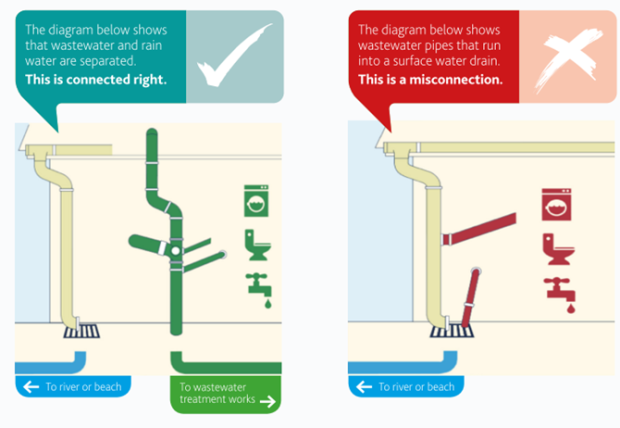
Know your drains and prevent misconnections
- Check your plumbing to make sure your wastewater (including from appliances) is going to the right drains. Incorrect plumbing can cause pollution. Find out more at Connecting your home to the right drains | nidirect.
- Only rain should go down your outside surface drains! Drains flow straight into our rivers, lakes or onto our beaches.
Ensure correct disposal of chemicals and paints
- Dispose of chemicals, paints and used cooking oil at household waste recycling centres.
Look after your septic tank to keep it healthy
- Make sure it’s properly serviced
- You need a consent from the Northern Ireland Environment Agency. You can search the Domestic Consent Public Register to check if your property has a consent (all domestic consents and maps for consents granted from 1992 to present are available to download).
- If your property does not have a Domestic Consent you can apply online at Regulating water discharges | Department of Agriculture, Environment and Rural Affairs.
- Get it desludged regularly - Northern Ireland Water provide a free desludging service (once every 12 months, provided service conditions are met)
- Use household cleaning products sparingly and choose environmentally friendly options. Excessive use of bleach and detergents kills off the bugs in a septic tank which are needed to break down waste effectively.
Car wash care
- Preferably wash your car at a dedicated facility, but if washing at home, make sure that soapy water doesn’t go into storm drains that lead to rivers.
Prevent litter
- Litter can get washed into storm drains and directly into our waterways harming wildlife, including birds and fish and decreasing the oxygen levels in the water when it decays.
Limit chemical and pesticide use and disposal
- Never allow entry of chemicals or pesticides into any water system including drains, sinks, toilets, waterways, ditches.
- Don’t put chemicals or pesticides in your bin unless the label says you can. Dispose as per instructions on label.
- Don’t put chemicals or pesticides on a garden bonfire.
Disposal of medicines
- Return out-of-date or no longer required medicines to your pharmacy. Never ever bin them or flush them down the toilet.
Don’t flush it, bag it and bin it
- Only the 3 Ps – pee, poo and paper should go down the toilet – any other waste (such as sanitary items, nappies, wipes, cotton buds) can cause blockages, and should be bagged and binned hygienically. Also bin wipes labelled ‘flushable’. ‘Flushable’ just mean it disappears from your toilet, but the wipes still block the sewer system, as they don’t break down in water. Find out more at Bag it And Bin it - Northern Ireland Water.
Save water
- Using less water in our daily lives, means that less dirty water (sewage) is produced. Smaller amounts of sewage means that the risk of sewage spills is also smaller, as the spills are caused by capacity problems in the sewerage system.
Report Invasive Species
- Invasive Species are an issue across Northern Ireland – use the iRecord app to help identify invasive species and record their location to help experts to take the appropriate action.
- Find out more about Invasive Species at Invasive Species Northern Ireland – Invasive Species Northern Ireland.
Find out more about the simple steps you can take to make a positive contribution to water quality in your local area in this leaflet NIEA Water Pollution Leaflet - You're the solution to Water Pollution | Department of Agriculture, Environment and Rural Affairs.